Modernizing Photovoltaic Asset Audits: Inside WThink’s Solar Panel Inspection API
Managing multi-gigawatt photovoltaic assets presents an operational dilemma: visual data collection has become faster thanks to automated drones and fixed PTZ surveillance, but the backend analysis remains heavily manual. In vast utility-scale or complex mountain solar installations, identifying displaced modules, auditing physical inventory, and maintaining a digital asset ledger still consume hundreds of engineering hours.
To solve this, WThink has introduced an advanced iteration of its vision intelligence platform: the Solar Panel Detection 2 API. Engineered not just for basic detection, but for comprehensive asset auditing and spatial distribution analysis, this algorithm provides a flexible software foundation for solar O&M platforms, EPC contractors, and drone analytics providers.
Tech Explainer: How Enterprise Vision APIs Are Delivered & Executed
To integrate algorithmic intelligence into existing industrial software, engineering teams must evaluate more than just model accuracy—they must evaluate deployment architecture. WThink delivers its vision algorithms via multiple flexible formats:
RESTful / gRPC Cloud Inference
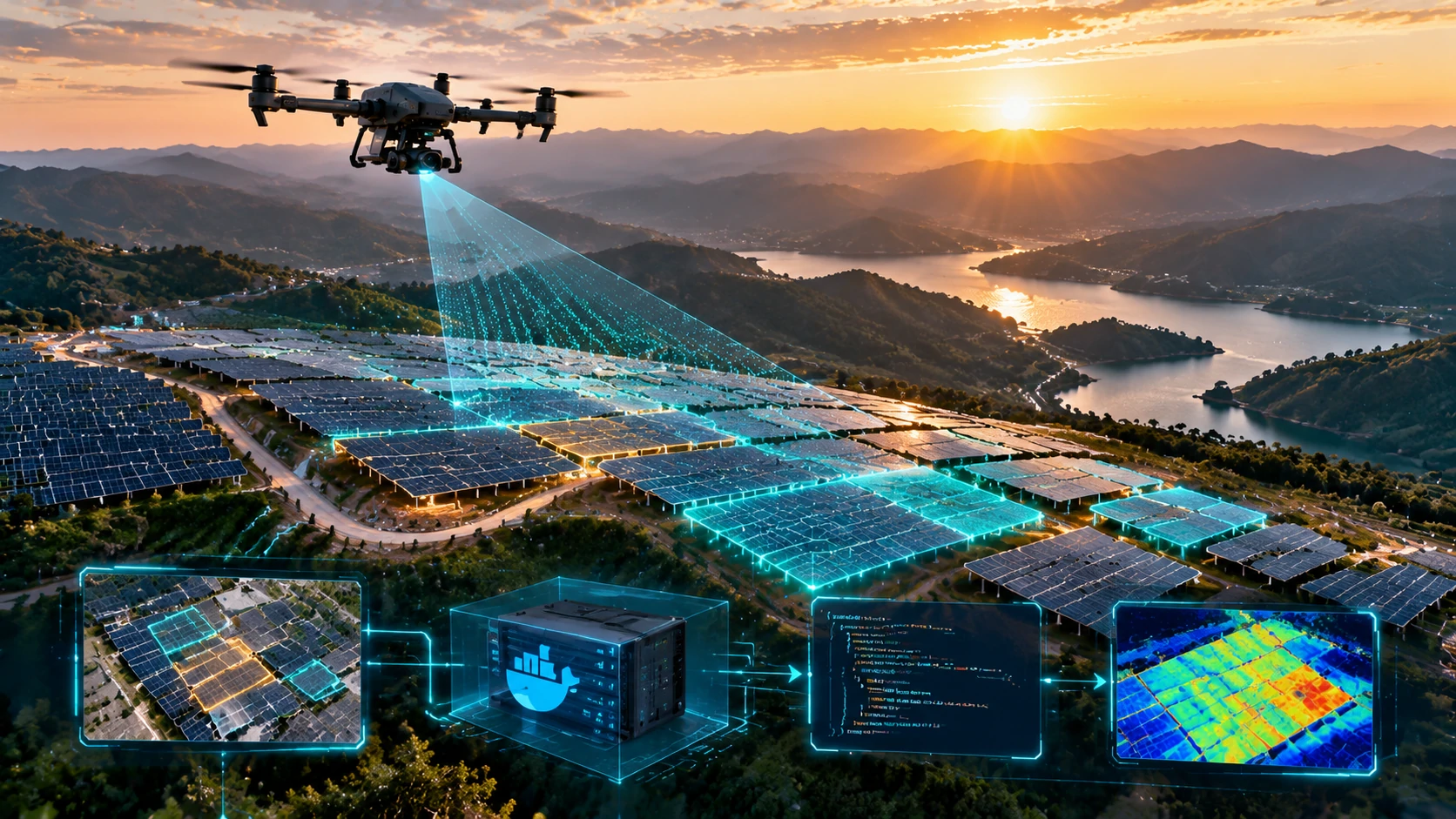
In cloud-connected environments, inspection images are submitted via standard HTTP/HTTPS multipart requests. The server passes the payload through a high-throughput GPU inference cluster and responds with structured JSON:
- Bounding Box Vectors: Exact normalized coordinate matrices locating every module within the frame.
- Spatial Distribution Metrics: Density and array alignment calculations.
- Anomaly Flags: Confidence-weighted alerts for missing, misaligned, or heavily shaded modules.
Containerized Edge Deployment (Docker)
In many critical energy installations, strict cybersecurity policies or remote geography prohibit continuous cloud streaming. WThink addresses this by distributing production-ready Docker containers compatible with NVIDIA Jetson, Ascend, and industrial x86/ARM edge gateways (such as WThink HUBA1, HUBNX, and RobotEdge units). This ensures air-gapped operation where video decoding, frame sampling, and model inference run entirely within the plant’s local area network.
Core Capabilities: Beyond Simple Bounding Boxes
While basic computer vision models only recognize rectangular shapes, WThink’s Solar Panel Detection 2 is built for real-world O&M operational workflows:
Dynamic Asset Inventory & Ledger Syncing
Instead of simply returning total counts, the API structures detection outputs to correspond with physical array strings. This allows automated reconciliation against plant SCADA records and EPC design blueprints.
Multi-Modal Feed Ingestion
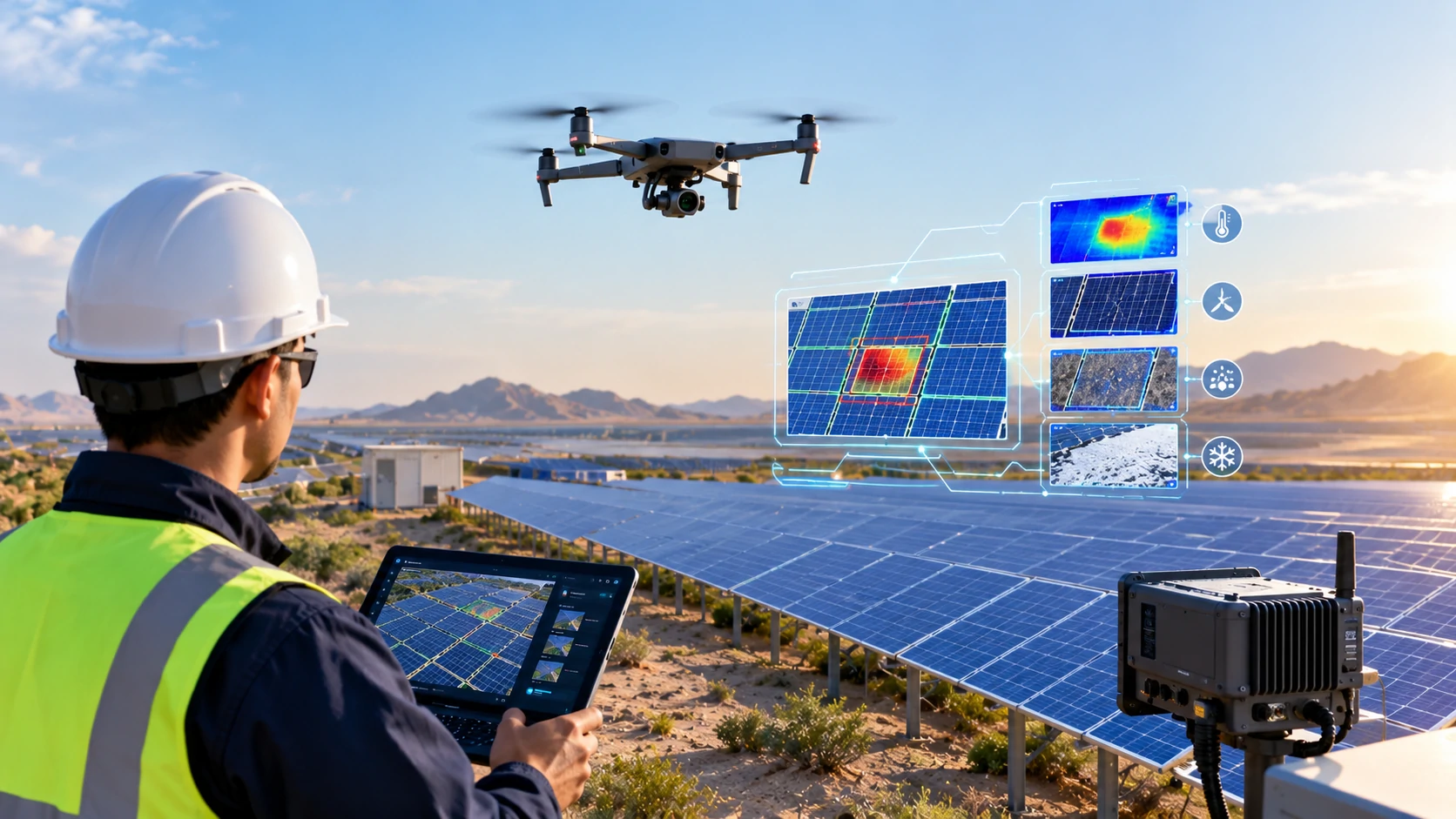
The pipeline handles varied input modalities with equal stability—from high-altitude orthomosaics generated during a solar farm drone inspection, to oblique video streams captured by ground rovers or stationary perimeter cameras.
Preliminary Structural Anomaly Indexing
The algorithm automatically isolates modules exhibiting severe angular displacement, foreign object occlusion, or surface damage. Crucially, these indexed coordinates can be passed downstream to guide subsequent thermal imaging flights for pinpoint PV hotspot detection.
Automated Audit Trails
Every analyzed frame generates a permanent, tamper-proof structured record, establishing historical baselines to monitor terrain settlement or long-term rack degradation.
The Power of Continuous Optimization: Transfer Learning for Site Variations
A common pitfall in industrial computer vision is “domain shift”—a model trained on flat desert utility farms often experiences degraded precision when deployed across floating solar plants or steep agrivoltaic farms with unusual tilt angles.
WThink resolves this through an incremental fine-tuning pipeline:
-
01
Standardized Annotation Guidelines
Clients receive pre-configured annotation templates and baseline weights.
-
02
Few-Shot Transfer Learning
Rather than collecting tens of thousands of new images, the system can be fine-tuned using just 100–300 site-specific field samples.
-
03
Rapid Docker Image Updates
The updated weights are repackaged into a localized update container, ensuring consistent high-precision detection across changing seasons, lighting conditions, and module form factors.
Frequently Asked Questions (FAQ)
Q1: What is the primary difference between WThink’s initial panel detection model and Detection 2?
While the primary model focuses on high-speed localization and raw counting, Detection 2 incorporates advanced spatial distribution mapping, tighter defect-tagging thresholds, and dedicated optimization for high-density arrays in complex terrains. It also offers enhanced edge-packaging options for direct deployment on industrial NVRs and robotics.
Q2: Can this API run without an active internet connection?
Yes. By deploying WThink’s containerized Docker package onto local industrial edge servers, on-premise NVRs, or portable edge computing boxes, inference runs entirely offline without external data transmission, complying with strict utility security protocols.
Q3: How does the algorithm process continuous RTSP video feeds from surveillance cameras?
The integration framework utilizes an intelligent frame-sampling pipeline. Rather than processing redundant 30 FPS feeds, the API samples keyframes at configurable intervals (e.g., 1 frame per second or upon motion trigger), minimizing compute overhead while ensuring instantaneous anomaly flagging.
Q4: How does this API support multi-vendor hardware environments?
WThink maintains a hardware-agnostic architecture. The API ingests standard image formats and video protocols regardless of whether they originate from DJI enterprise aircraft, Autel drones, fixed third-party PTZ cameras, or handheld mobile inspection devices.
Transform Your Solar Analytics with WThink APIs
Moving toward autonomous solar operations requires software that integrates cleanly into existing enterprise IT/OT environments. With WThink’s Solar Panel Detection 2 API, asset owners and software developers gain an industrial-grade vision engine that reduces manual review workloads, safeguards asset integrity, and accelerates digital transformation.
Explore the complete API specification, test live models, and review deployment packages by visiting the WThink algorithm platform today.