Automating Workplace Safety: A Technical Deep Dive into WThink’s PPE Detection API
In heavy manufacturing, thermal power generation, and chemical processing facilities, the difference between a near-miss and a severe workplace injury often comes down to a single piece of protective gear. Despite stringent regulatory standards, safety officers cannot be everywhere at once. Traditional safety enforcement—relying on manual spot checks and retrospective security footage audits—fails to prevent accidents as they unfold.
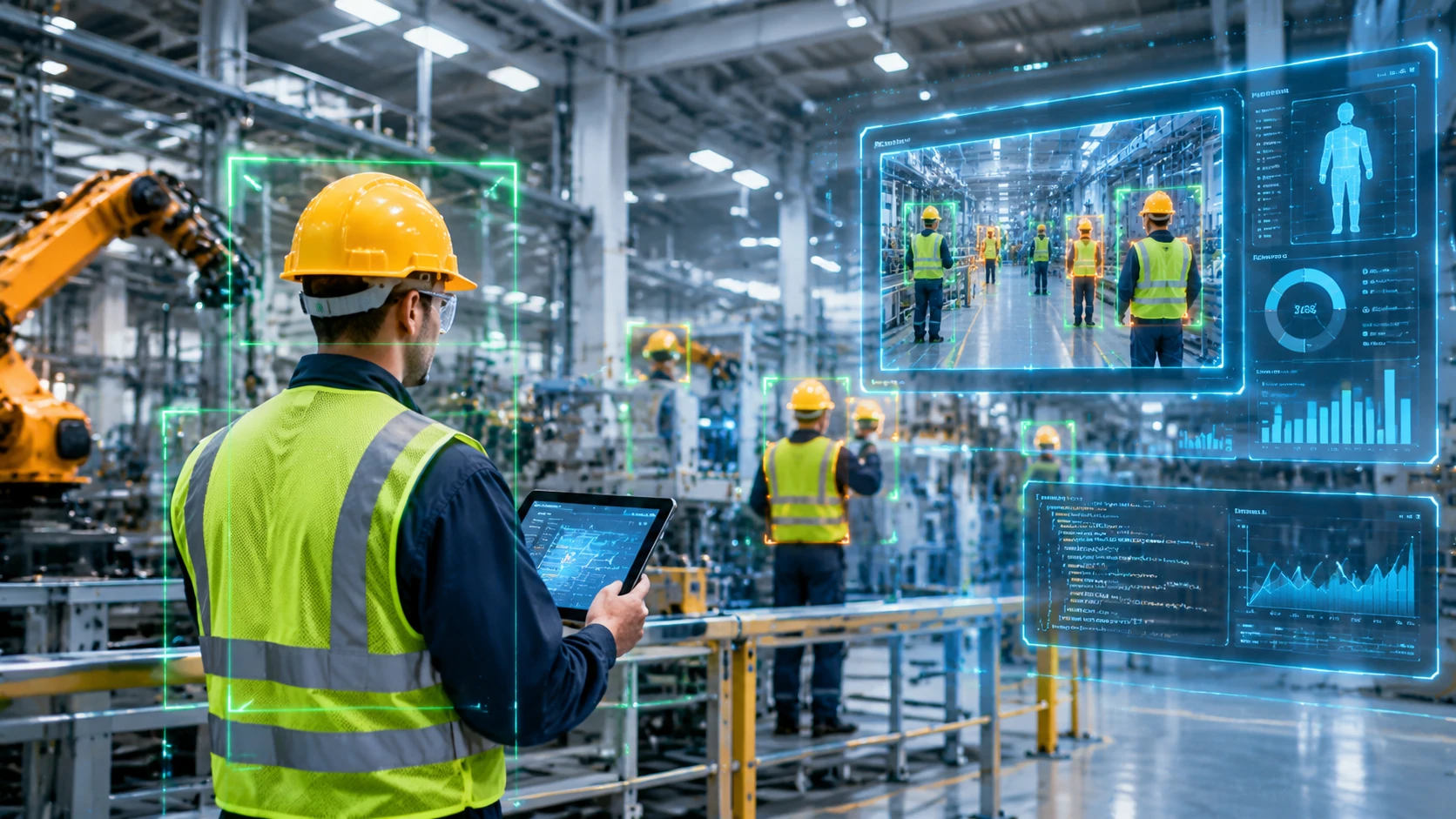
To close this operational safety gap, modern enterprises are turning to computer vision. WThink’s Personnel and Safety Equipment Detection API transforms passive CCTV cameras and inspection streams into an active AI safety monitoring system. By processing video feeds directly at the edge or via the cloud, the algorithm automates compliance verification, providing millisecond-level alerting for missing safety gear.
Tech Explainer: How AI Detects PPE (The Computer Vision Pipeline)
Automated PPE compliance verification is more complex than standard object identification. The algorithm must resolve complex spatial hierarchies—ensuring that a detected helmet is physically worn by a specific worker, rather than simply sitting on a workbench nearby.
1. Hierarchical Multi-Class Object Detection
WThink’s detection architecture utilizes a hierarchical neural network framework that executes inference in synchronized stages:
Anchor Localization
The primary network locates human bodies within the frame (person), establishing spatial bounding coordinates and tracking IDs across video frames.
Anatomical Sub-Region Cropping
The model isolates anatomical sub-regions (the head region and upper torso) based on human pose keypoints.
Classification & Attribute Binding
Within these localized bounding regions, dedicated classification layers determine the presence and type of gear:
- Hard Hats: Classifying distinct operational roles via color: Blue, Red, White, and Yellow.
- Torso Gear: Identifying whether a Reflective Vest is present and properly worn.
2. Why Hard Hat Colors Matter: Beyond Binary Detection
Basic open-source models often treat helmets as a single binary class (“wearing a hat” vs. “not wearing a hat”). In industrial environments, however, helmet color denotes functional responsibility:
White
Site managers, civil engineers, or external inspectors.
Blue
Electrical contractors or specialized technicians.
Yellow
General heavy-equipment operators or site laborers.
Red
Safety supervisors or emergency response crew.
By distinguishing colors at the API level, WThink enables Role-Based Safety Verification. For example, if a worker wearing a yellow helmet enters a high-voltage switchyard reserved exclusively for certified personnel (blue/white helmets), the API immediately flags an unauthorized zone intrusion, even if standard safety gear is present.
Core Architectural Advantages of WThink’s Safety API
Robust in Industrial Visual Clutter
Standard factory environments contain flashing machinery, steam, harsh shadows, and reflective scaffolding. The WThink algorithm is pre-trained on diverse real-world plant datasets to prevent false positives caused by fluorescent structural elements or bright clothing.
Occupancy & Head-Count Analytics
In addition to PPE compliance, the system continuously aggregates head counts within designated camera zones, enabling automated enforcement of room occupancy thresholds in confined or hazardous spaces.
Lightweight Edge-Optimized Weights
The model architecture is optimized for real-time inference on low-power silicon, including Rockchip (RK3588), NVIDIA Jetson Orin series, and WThink dedicated edge boxes (HUBA1, HUBNX, M3X, RobotEdge).
Implementation: From RTSP Video Stream to Business Action
A vision API must integrate cleanly into existing operational technology (OT) and enterprise software. WThink’s algorithm services operate across three scalable stages:
-
Step 1
Video Ingestion
Connect existing on-site IP cameras directly to the processing node via RTSP (Real-Time Streaming Protocol) or submit static patrol photos via standard HTTP POST payloads. There is no need to replace existing camera infrastructure.
-
Step 2
Edge Inference & Frame Decimation
To minimize processing load while ensuring continuous safety, the edge appliance samples keyframes (e.g., 5 to 10 FPS) from the video stream. If no human presence is detected, the pipeline remains in a low-power listening state, maximizing computational headroom across multi-channel NVRs.
-
Step 3
Event-Driven Automation
When a violation occurs (such as an unfastened vest or absent helmet), the API payload triggers immediate downstream workflows:
- Turnstile Interlock: Halting workshop access gates until the worker puts on required gear (“No PPE, No Entry”).
- Audible & Visual Alarms: Activating local beacons or PA systems to alert workers on the floor.
- Incident Logging: Saving timestamped, cropped violation snapshots to the central safety ledger for weekly compliance reporting.
Frequently Asked Questions (FAQ)
Q1: Can the algorithm detect PPE compliance from extreme camera angles or long distances?
The system is engineered to handle wide-angle overhead surveillance and oblique camera perspectives typical of industrial plant ceilings. For accurate helmet color classification, a minimum target head size of approximately 32×32 pixels is recommended within the frame.
Q2: How does the API handle crowded work areas with overlapping personnel?
WThink utilizes non-maximum suppression (NMS) coupled with spatial keypoint tracking. Even when workers temporarily cross paths or obscure one another, the tracking pipeline maintains unique identities, recalculating attribute compliance the moment the occlusion clears.
Q3: What network bandwidth is required to run the PPE detection system?
When deployed using WThink edge compute modules (such as the HUBNX or edge NVRs), the raw video stream never leaves the local network. Only lightweight JSON telemetry (a few kilobytes per alert) is transmitted to central servers or SCADA dashboards, minimizing corporate network bandwidth.
Q4: Is it possible to train the model on custom company uniforms or branded vests?
Yes. While the base model accurately identifies standard international reflective vests and colored helmets, WThink provides incremental transfer learning pipelines. By providing 100 to 300 site-specific photos of unique uniform patterns, our engineering team can fine-tune weights for specialized plant aesthetics.
Build a Safer Industrial Future with WThink
Workplace accidents introduce severe regulatory liabilities, operational delays, and human costs. Deploying WThink’s Personnel and Safety Equipment Detection API allows industrial safety managers, systems integrators, and software platforms to build proactive, 24/7 automated compliance networks across every corner of the enterprise.
Access model documentation, request developer API credentials, or schedule a custom integration review by connecting with the WThink technical team today.