AI vision is changing the way wind farms find blade defects. Combine drone imagery, intelligent defect recognition, and a structured inspection workflow, and operators catch damage earlier — and plan maintenance with far more consistency than manual review ever allowed.
Why blade defect detection matters
Wind turbine blades take a punishing load every single day — high wind, rain, dust, sand, salt spray, UV exposure, lightning, temperature swings, and constant vibration. Eventually, that wear shows up as surface damage, material degradation, and emerging structural risk.
Most blade defects don’t fail a turbine outright. They quietly erode aerodynamic efficiency, increase vibration, push up maintenance costs, and shorten asset life. Let a small crack, erosion patch, or sign of delamination sit too long, and what could have been a coating touch-up becomes a major repair — with the downtime to match.
At wind-farm scale, detection alone isn’t enough. Operators need to classify defect types, judge severity, compare findings over time, and prioritize maintenance across dozens or hundreds of turbines.
AI vision turns blade inspection from a manual image-review chore into a structured, repeatable, data-driven maintenance discipline.
How AI vision supports wind turbine inspection
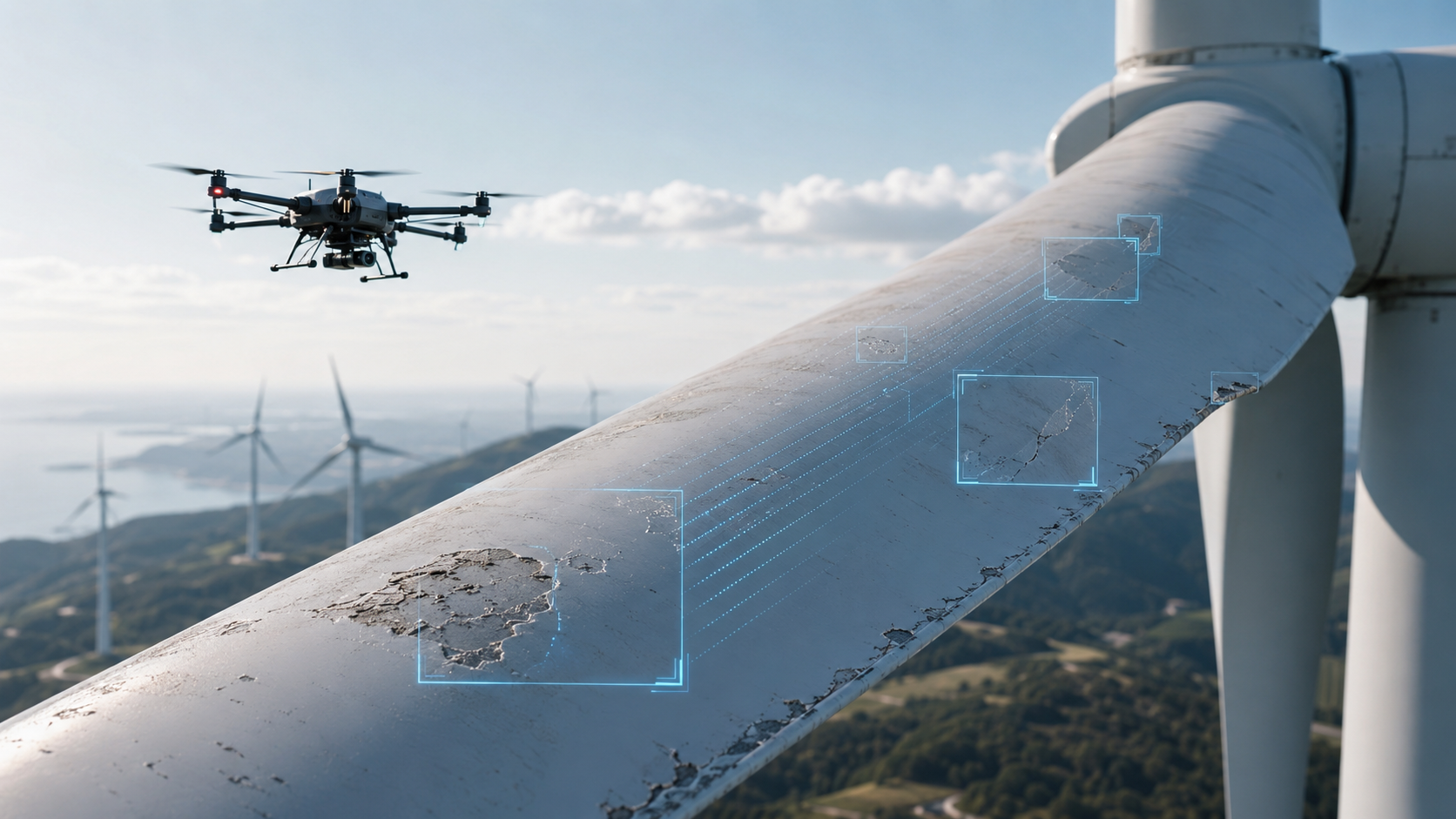
AI vision systems analyze visual data captured by drones, cameras, and other inspection devices. For wind turbines, drones typically circle each blade and shoot high-resolution imagery from every angle. AI algorithms then process those images to flag visible defects, group findings, and feed structured reports.
Compared with pure manual review, an AI-driven workflow flags suspect blade areas, pinpoints defect locations, classifies common damage types, and lines new inspection data up against historical records — all of which lighten the load on inspection teams and deliver more consistent results across sites.
WThink’s Wind Power solution is built around this connected approach, bringing Industrial AI, autonomous inspection, edge computing, 5G connectivity, and centralized monitoring together as a single system.
Common blade defects detected by AI vision systems
AI vision shines on surface-level, image-visible damage. These are the defect categories most often monitored in modern wind turbine blade inspection.
Leading edge erosion
Coating wear, rough surfaces, and material loss from years of impact with rain, dust, sand, and airborne debris.
Surface cracks
Visible cracks, scratches, punctures, and the early structural warning signs that grow fast under repeated load.
Lightning strike damage
Burn marks, discoloration, puncture points, coating damage, and the other visual fingerprints lightning leaves behind.
Delamination signs
Bubbles, surface separation, deformation, wrinkles, and other irregular patterns that suggest blade layers are pulling apart.
Trailing edge separation
Split lines, bonding failures, edge openings, and deformation along the trailing edge — where aerodynamic stress concentrates.
Blade tip damage
Wear, deformation, cracks, missing material, and impact damage at the tip — the spot most prone to aerodynamic disruption.
Coating loss
Paint loss, protective coating failure, discoloration, and surface degradation that strip the blade’s first line of defense.
Contamination and staining
Oil stains, dirt buildup, bird strikes, salt residue, and other surface conditions that quietly drag down performance.
Leading edge erosion
Leading edge erosion is the most common blade defect on most wind farms. It develops along the front edge of the blade, where rain, dust, sand, and particulates strike the surface at hundreds of kilometers per hour. Over time, the protective coating wears through and the underlying blade surface roughens up.
The aerodynamic toll is real — lost efficiency, more noise, more vibration. AI vision detects erosion patterns by comparing surface color, texture, edge profile, and visible coating loss across blade imagery.
Early detection is what keeps the repair cheap. Light erosion responds to coating treatment; advanced erosion means structural repair work and serious downtime.
Cracks and structural warning signs
Cracks emerge from fatigue, impact damage, material aging, manufacturing flaws, or accumulated long-term stress. Some are shallow and stable. Others are the first visible sign of trouble running deeper into the blade structure.
AI vision helps surface cracks by picking up narrow lines, abnormal surface breaks, and contrast discontinuities in high-resolution imagery. With consistent inspection data, it also tracks whether a crack is stable, expanding, or showing up across repeated cycles.
AI doesn’t replace engineering judgment — it gets suspect areas in front of specialists faster, so they can spend their time on verification and decisions, not on screening photos.
Lightning strike damage
Wind turbines are tall, exposed, and conductive — exactly the kind of target lightning finds. Strikes leave burn marks, dark spots, punctures, cracks, coating loss, or deformation. Sometimes the damage is unmistakable. Often it’s subtle enough that careful image review is the only way to catch it.
AI vision flags the visual patterns associated with lightning impact, queuing them up for maintenance engineers to review and decide whether electrical or structural follow-up is warranted.
For wind farms in lightning-prone regions, structured post-storm visual records are gold. They make it possible to track blade condition after every event and plan response without guesswork.
Delamination and surface separation
Delamination is what happens when blade material layers start coming apart. Early signs are easy to miss — small bubbles, faint wrinkles, slight surface deformation, unusual shadows, texture shifts. From the ground, almost impossible to spot. On upper blade surfaces, even harder.
Drones get the close-up coverage that ground inspection can’t, and AI vision picks out the surface patterns that hint at layer separation. Findings then move into the queue for closer manual verification or advanced inspection methods.
Delamination doesn’t stay small. Catching it early is the difference between a contained repair and a major structural intervention.
Trailing edge and blade tip defects
The trailing edge and blade tip carry an outsized share of aerodynamic and structural load. Damage in either region drives vibration, noise, efficiency loss, and added stress everywhere else on the blade. Common issues: edge separation, bonding failure, cracks, deformation, missing material, impact damage.
AI vision tackles these by analyzing edge continuity, shape changes, visible gaps, and abnormal surface patterns. Multi-angle drone imagery gives operators a complete view of the regions that are hardest to inspect any other way.
How AI helps classify severity
Finding a defect is the easy part. The harder question is how bad it is. AI vision groups defects by size, location, visual signature, and historical patterns — moving teams from a flat defect list to a real maintenance priority queue.
A patch of surface staining might warrant nothing more than a watchlist entry. A long crack near a high-stress zone demands immediate review. An erosion pattern repeating across multiple turbines signals a site-level environmental issue that needs broader planning. AI gets you to those distinctions faster.
The result: more consistent inspection reports, especially when many turbines and many blades have to be reviewed inside a tight maintenance window.
A practical AI blade inspection workflow
Collect high-resolution blade images
Drones capture imagery of the blade root, leading edge, trailing edge, tip, pressure surface, and suction surface.
Identify suspected defects
AI vision algorithms scan the image set for cracks, erosion, delamination signs, lightning marks, coating loss, and surface abnormalities.
Group findings by defect type
Detected issues get organized by blade, turbine, location, defect category, and severity level.
Engineer verification
Maintenance specialists review the AI findings, confirm severity, and decide whether further inspection or repair is needed.
Build long-term blade history
Inspection records get stored and compared across future cycles, tracking defect development and repair outcomes over time.
Why edge AI and connectivity matter
Wind farms live in the places connectivity forgot — remote ridges, offshore platforms, wide-open plains. Field conditions and data transfer aren’t always cooperative. Edge AI and industrial connectivity are what make inspection workflows actually practical in those environments.
Edge AI pushes processing closer to the field, cutting latency and enabling fast preliminary analysis on site. 5G and industrial wireless then move inspection data, video streams, device telemetry, and mission information back to the control center without the usual remote-site bottlenecks.
WThink supports this connected inspection model with the Autonomous Inspection System, WD5500 edge AI module, and M3X 5G drone data link module.
Benefits for wind farm maintenance teams
Earlier defect discovery
AI-assisted inspection catches blade problems while they’re still small enough for a light, targeted repair.
More consistent reporting
AI classification standardizes defect categories, image records, and inspection outputs across every turbine in the fleet.
Reduced manual review workload
Inspection teams focus on prioritized findings instead of grinding through every image from scratch.
Better maintenance prioritization
Defect type, size, location, and severity indicators show teams exactly which blade issues to tackle first.
Improved historical comparison
Structured data makes blade-condition comparison across inspection cycles trivial — and defect tracking automatic.
Safer field operations
AI drone inspection cuts unnecessary manual screening and frees technicians for targeted verification and repair work.
AI vision and human expertise, side by side
AI vision is a powerful tool. It is not a substitute for engineering expertise. Blade defects vary with material, turbine model, operating environment, and maintenance history — and some findings demand specialist review, physical verification, or advanced testing before any decision gets made.
The strongest workflow pairs AI-assisted detection with expert judgment. AI does the volume work — fast, consistent screening across massive image sets. Engineers do the high-value work — confirming severity, diagnosing root cause, and deciding the right repair strategy.
The common wind turbine blade defects AI vision systems catch include leading edge erosion, cracks, lightning strike damage, delamination signs, trailing edge separation, blade tip damage, coating loss, and contamination. Bring drone inspection, AI vision, edge computing, and a connected inspection platform together, and wind farm operators get earlier detection, standardized reporting, lower inspection workload, and a maintenance strategy built on real data — exactly what long-term wind power operations demand.
Frequently asked questions
What are the most common wind turbine blade defects?
Leading edge erosion, cracks, lightning strike damage, delamination, trailing edge separation, blade tip damage, coating loss, and contamination — those are the defect categories that dominate most wind-farm inspection data.
How does AI vision detect blade defects?
AI vision analyzes drone-captured imagery and identifies visual patterns — cracks, erosion textures, surface deformation, discoloration, missing material, abnormal edge shapes — that match known defect types.
Can AI determine blade defect severity?
AI handles a first-pass severity classification based on defect size, location, visual features, and comparison with historical records. Final maintenance calls still belong to engineering review.
Does AI vision replace manual blade inspection?
No. AI vision sharpens screening, classification, and reporting. Technicians and engineers remain essential for hands-on verification, structural evaluation, and the actual repair work.
Why use drones for blade defect detection?
Drones get close-up imagery of every blade surface without putting technicians on ropes — making inspection faster, safer, and scalable across utility-sized wind portfolios.