Wind turbine blades take a constant beating — from wind, rain, lightning, dust, temperature swings, and mechanical load. Drone inspection gives wind farm operators a safer, faster way to catch blade damage before small defects turn into expensive downtime.
Why blade inspection is critical for wind farm performance
Wind turbines are built to run for decades in some of the harshest outdoor conditions on the planet. Blades carry the heaviest burden — they drive aerodynamic efficiency, power output, vibration behavior, structural integrity, and ultimately turbine safety. Even minor blade defects can chip away at generation and pile extra mechanical stress onto the entire system.
The damage list is long: leading edge erosion, cracks, coating wear, lightning strike marks, delamination, tip damage, surface contamination, and structural fatigue. Some are visible from the ground; many are not. Most require close-up, high-resolution imaging to evaluate properly.
For utility-scale wind farms, inspection isn’t just maintenance overhead. It’s part of asset protection, operational planning, safety management, and long-term ROI.
The earlier a defect is found, the cheaper it is to fix. Early detection means lighter repairs, less downtime, and far less risk of secondary damage spreading through the blade.
The limitations of traditional manual inspection
Traditional blade inspection relies on rope access, ground-based telescopes, work platforms, or handheld photography. These methods still have their place — especially when hands-on repair or close physical verification is needed — but the limitations are hard to ignore.
Rope access puts trained technicians on the side of a turbine, dependent on tight weather windows and significant time on each unit. Ground-based inspection avoids the safety risk but struggles to capture useful detail on the upper blade surfaces, especially the leading edge and tip.
Consistency is another challenge. Across a large wind farm, different inspectors shoot different angles, apply different judgment, and log findings in different formats. Comparing blade condition over time — or across turbines — gets harder with every inspection cycle.
How drone inspection changes the workflow
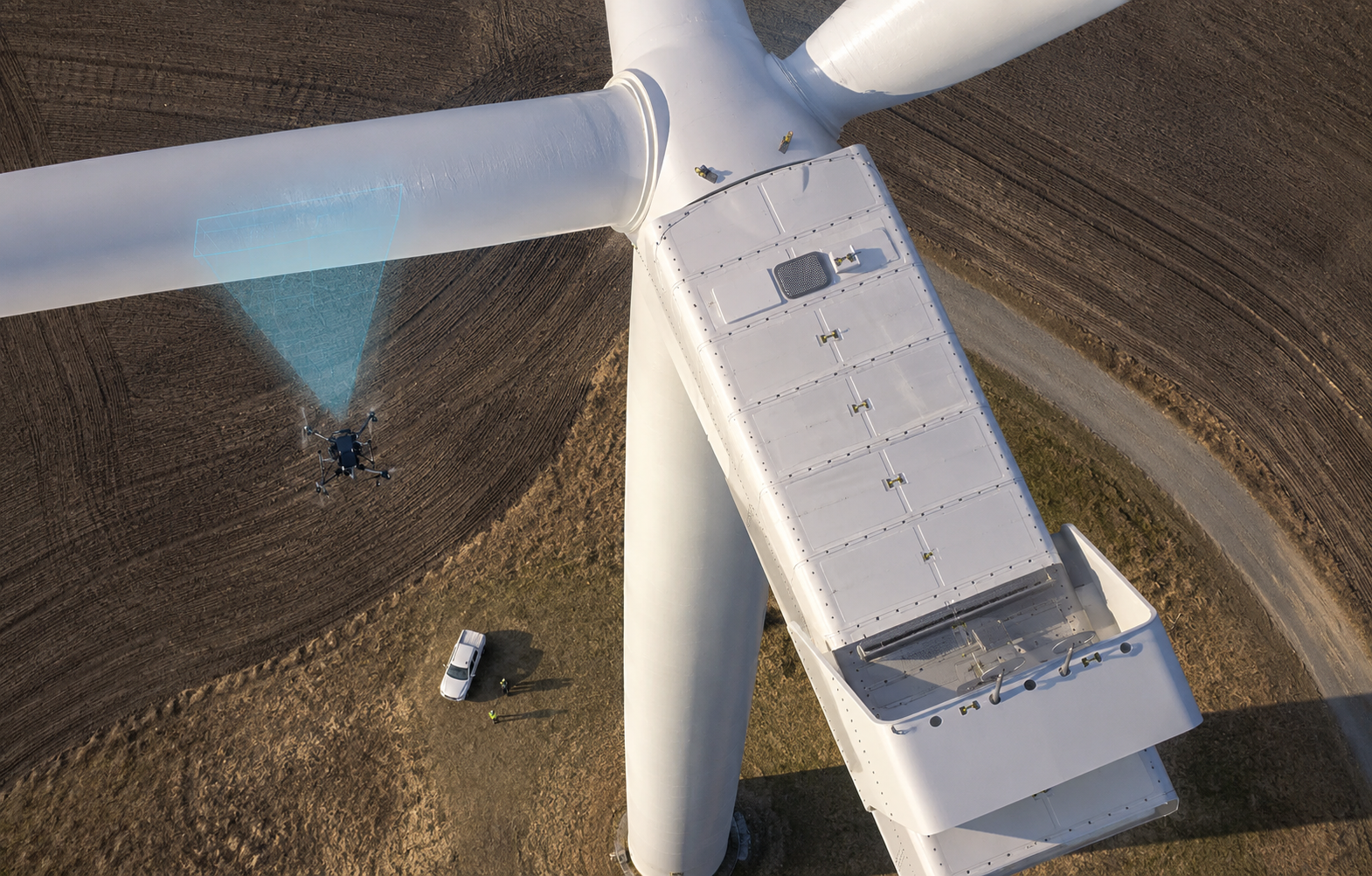
Drones flip the script. Instead of sending technicians up the tower, a drone flies around each blade and captures high-resolution imagery from every required angle — leading edge, trailing edge, root, tip, pressure side, suction side.
Pair that with AI analysis, thermal sensing, 5G connectivity, edge computing, and structured inspection software, and aerial photography becomes something more useful: a repeatable workflow that classifies defects, maps them to specific blade locations, drives repair planning, and feeds into long-term asset monitoring.
WThink’s Wind Power solution is built around exactly this kind of connected inspection — autonomous flight, Industrial AI, field-side intelligence, and centralized monitoring working as a single system.
Blade damage that drone inspection can detect
The power of drone inspection lies in access. Drones reach surfaces and angles that ground crews can’t see and rope teams take hours to examine. With the right camera setup and inspection routine, operators catch both obvious defects and the subtler patterns worth investigating.
Leading edge erosion
Coating wear, surface roughness, and material loss caused by years of impact from rain, dust, sand, and airborne debris.
Cracks and surface damage
Visible cracks, scratches, punctures, and early warning signs of structural issues that worsen quickly under load.
Lightning strike marks
Burn marks, discoloration, punctures, and other tell-tale signs left behind by lightning impact and arc damage.
Delamination signs
Surface separation, blistering, deformation, and other irregularities that suggest layers of the blade are pulling apart.
Tip and trailing edge issues
Tip wear, trailing edge separation, bonding failures, and damage concentrated in the highest-stress sections of the blade.
Contamination and foreign matter
Dirt buildup, oil residue, bird strikes, and surface contamination that quietly drag down aerodynamic performance.
Why drone inspection is safer
Safety is the single biggest reason wind operators move to drones. Traditional blade inspection means work at height, rope access, heavy lifting gear, and long hours exposed to the elements. Drones remove most of that from routine screening.
Instead of climbing every turbine on a fixed schedule, crews can fly first — find the damage, prioritize which turbines actually need hands-on work, and only send people up when there’s a real reason to.
Weather windows get easier too. A well-planned drone mission captures the data it needs in the brief calm between fronts, cutting on-site exposure and pulling the whole inspection cycle into safer territory.
How AI sharpens blade damage detection
A single inspection cycle across a wind farm generates thousands of images. Reviewing all of them by hand is slow, fatiguing, and inconsistent. AI is what turns that pile of imagery into structured inspection intelligence.
AI-driven defect analysis flags damage, groups findings by type, ties each one to a specific blade region, and helps grade severity. Maintenance teams come away knowing what happened, where it happened, and what needs attention first — not just a folder full of photos to sort through.
Drones capture the data. AI turns that data into maintenance decisions you can actually act on.
For operators running multiple wind farms, AI also unlocks historical comparison. You can track blade condition across inspection cycles, surface recurring defect patterns, and apply consistent repair priorities across the whole portfolio.
A practical wind turbine drone inspection workflow
Define inspection scope
Lock in which turbines, blade zones, camera specs, weather windows, safety perimeters, and data quality standards apply before anyone takes off.
Collect blade image data
Drones fly the planned routes and capture high-resolution imagery from every required angle — leading edge, trailing edge, tip, and root.
Use AI-assisted defect detection
AI sweeps the image set, identifies blade defects, classifies damage types, and organizes findings by turbine, blade, location, and severity.
Generate structured inspection results
Findings are packaged into clear reports — annotated images, defect descriptions, exact location references, and concrete next steps.
Plan repair and track history
Maintenance teams prioritize work, verify completed repairs, and follow blade condition trends across every future inspection cycle.
The role of edge AI and 5G connectivity
Wind farms sit where the wind is — offshore platforms, mountain ridges, open plains, remote desert sites. Network coverage and field access are rarely ideal. Edge AI and 5G connectivity address that head-on.
Edge AI pushes some of the computing right out to the drone or field device. That means lower latency, faster on-the-spot analysis, and quicker decisions at the inspection site itself. 5G and industrial wireless then carry images, video streams, device telemetry, and mission data back to the control center without the usual remote-site bottlenecks.
WThink supports this kind of connected workflow with products like the Autonomous Inspection System, WD5500 edge AI module, and M3X 5G drone data link module.
Benefits for wind farm operators
Reduced climbing risk
Routine rope-access inspections get replaced by aerial screening, keeping technicians off the tower unless they’re truly needed there.
Faster inspection cycles
Aerial inspection covers more turbines in less time than any manual screening method on the market.
More consistent records
Structured image capture and AI-assisted reporting build inspection records that hold up to year-over-year comparison.
Better repair prioritization
Defect classification and severity grading help teams focus on the turbines and blade issues that genuinely move the needle.
Lower operational disruption
Quick screening and targeted follow-up cut unnecessary downtime and free maintenance teams to schedule work more efficiently.
Portfolio-level visibility
Centralized inspection data lets operators compare blade condition across turbines, sites, and inspection periods at a glance.
Drones and technicians work better together
Drone inspection doesn’t replace blade technicians — it makes their work safer and more focused. Drones own site-wide screening, visual data capture, early defect detection, and repair prioritization. Technicians own what they’ve always done best: close verification, structural evaluation, repair, coating work, and component replacement.
The strongest maintenance programs combine both. Drones and AI flag the potential issue; technicians handle the targeted investigation and fix. Less unnecessary climbing, broader inspection coverage, better maintenance decisions — that’s the actual operational win.
Wind turbine drone inspection gives operators a safer, faster, and far more repeatable way to catch blade damage. With aerial imaging, AI analysis, edge computing, and connected inspection workflows working together, defects get found earlier, manual risk drops, and maintenance strategy gets a real data foundation underneath it. For modern wind farms, drone inspection isn’t just a visual tool — it’s a core part of running wind power operations safely and intelligently.
Frequently asked questions
What is wind turbine drone inspection?
It’s the use of UAVs to capture high-resolution imagery of turbine blades, towers, nacelles, and other components — letting operators detect damage without depending solely on climbing or ground-based inspection.
What blade damage can drones detect?
Leading edge erosion, cracks, lightning strike marks, delamination, tip damage, trailing edge issues, surface contamination, and visible structural defects — basically anything a high-resolution camera can resolve from the air.
Is drone inspection safer than manual blade inspection?
Significantly. Drones remove most routine work-at-height tasks and let teams pinpoint which turbines actually need a closer manual look, instead of climbing every unit on a fixed schedule.
How does AI improve wind turbine blade inspection?
AI processes thousands of blade images at speed, flags likely damage, classifies defect types, supports severity grading, and packages findings into structured inspection reports — work that would take human reviewers days to match.
Does drone inspection replace blade technicians?
No. Drones make screening and prioritization faster and safer; technicians remain essential for close verification, repairs, coatings, and any real maintenance work on the blade itself.