

Project Background and the Challenges of Rotating Machinery Wear
At a high-capacity 2x1000MW ultra-supercritical coal-fired power plant, the continuous operation of complex rotating machinery and high-stress auxiliary subsystems is vital to maintaining stable grid output. These critical assets include massive steam turbine generators, high-pressure cooling pumps, main hydraulic stations, and heavy-duty power inverters. Operating continuously under extreme thermal and mechanical stress, these components undergo natural physical degradation over time, including bearing wear, mechanical misalignment, lubricant breakdown, and thermal stress on power electronics. Traditionally, maintenance at this facility was conducted on a time-based schedule or a reactive basis, meaning technicians often had to wait for a component to physically break or fail before performing repairs, resulting in costly emergency interventions and prolonged forced outages during peak demand periods.
Limitations of Threshold-Based Alarm Systems
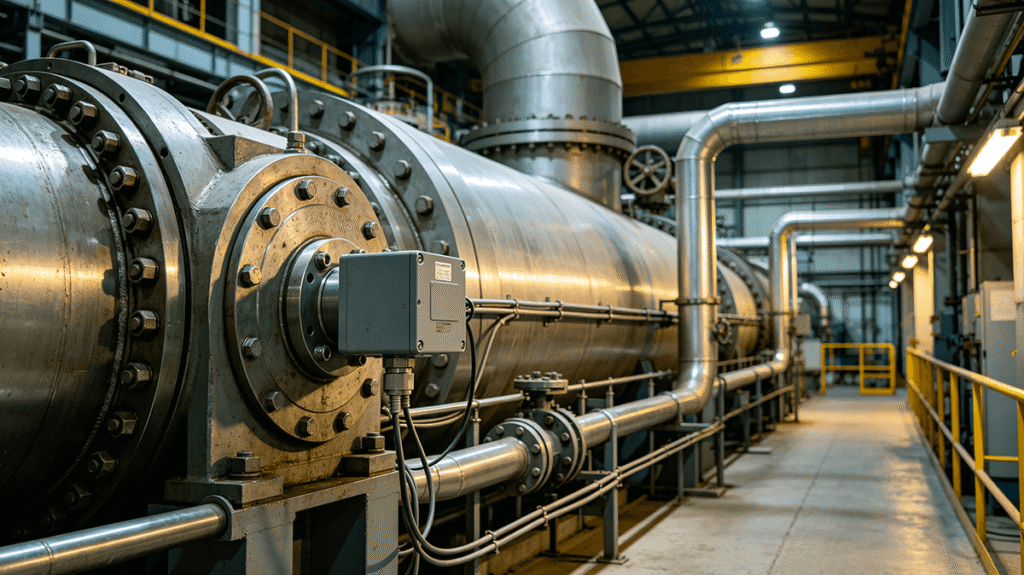
The drawbacks of reactive maintenance were particularly evident in the monitoring of large bearing housings and hydraulic pumps. Standard threshold-based monitoring systems only trigger alarms after a parameter has already crossed a critical danger limit—for instance, when a generator bearing is already severely overheating or a cooling pump is experiencing high-amplitude vibrations. By the time these threshold alarms are activated, internal physical damage has usually already occurred, necessitating expensive component replacements and extensive downtime. Furthermore, without a standardized way to analyze high-frequency acoustic and vibration waveforms, the plant’s maintenance team could not detect early-stage micro-anomalies or estimate the remaining useful life of key rotating parts, preventing the organization from planning proactive maintenance campaigns.
Deploying WThink’s Predictive Monitoring Solution
To transition from reactive firefighting to proactive asset management, the thermal plant implemented WThink’s Smart Alert Monitoring System to deliver Data-Driven Maintenance & Predictive Intelligence. The solution deploys a dense network of high-frequency vibration sensors, precision temperature probes, and pressure transducers across all critical auxiliary assets. These specialized sensors feed high-frequency physical data directly into an on-site edge-computing platform running advanced predictive analytics. By converting continuous mechanical waveforms and temperature trends into objective health indices, the system provides engineers with real-time awareness of equipment degradation long before a physical failure occurs.
Waveform Analysis and Multi-Parameter Fault Correlation
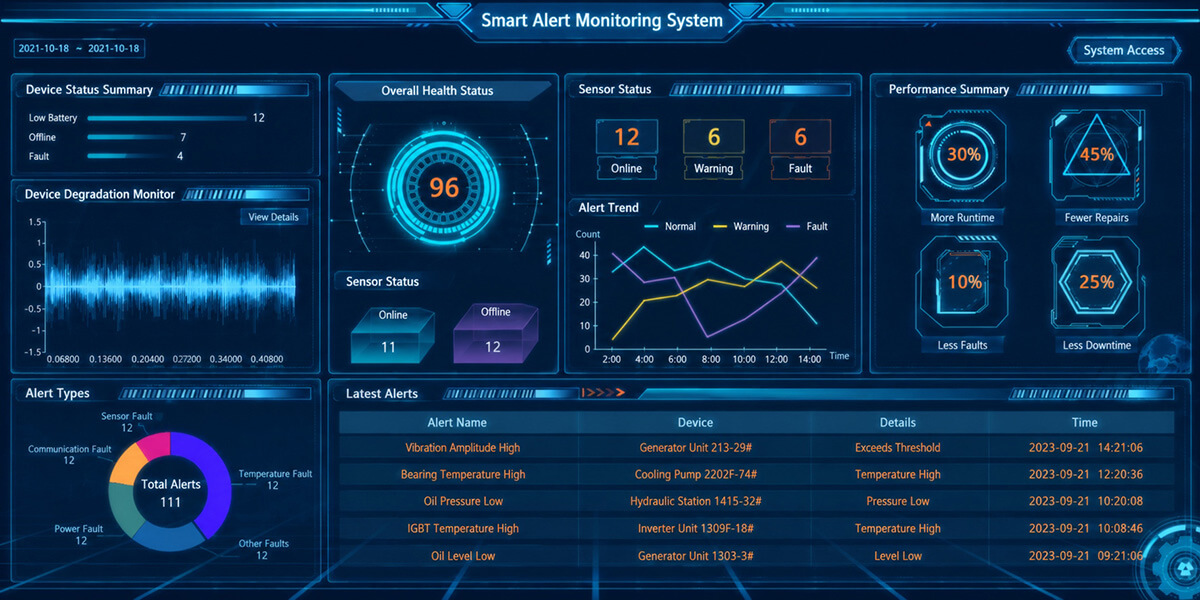
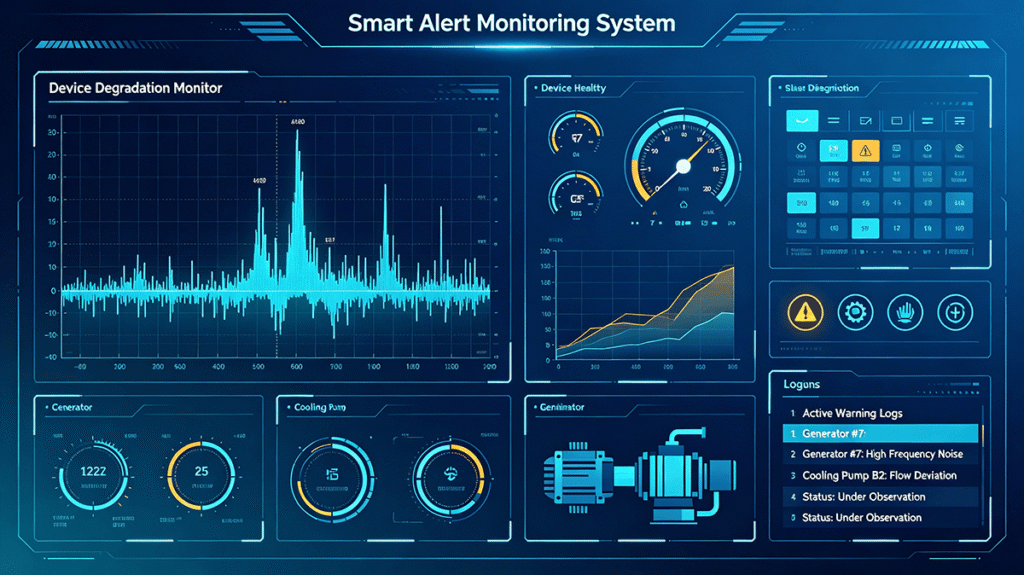
The predictive intelligence engine continuously processes sensor feeds through an advanced Device Degradation Monitor, which visualizes high-frequency vibration and acoustic emission waveforms. By comparing live vibration frequencies against historical mechanical baselines, the system’s algorithms can identify tiny structural anomalies—such as minor rotor imbalances, early-stage bearing inner-race wear, or subtle pressure fluctuations in hydraulic stations—without waiting for a hard threshold to be breached. When a warning arises, such as a high vibration amplitude on Generator Unit 213-29#, bearing temperature elevation on Cooling Pump 2202F-74#, or low pressure at Hydraulic Station 1415-32#, the platform correlates these parameters with operational histories. It automatically classifies the alert type, calculates an overall asset health index, and estimates the remaining useful life of the affected component, allowing the engineering team to schedule targeted repairs during planned low-demand windows.
Operational Results and Long-Term Business Value
The implementation of WThink’s Data-Driven Maintenance & Predictive Intelligence system has successfully transitioned the thermal plant to a proactive, predictive maintenance model. The platform has significantly optimized operations, delivering a forty-five percent reduction in emergency repair incidents, twenty-five percent less unscheduled equipment downtime, and a thirty percent increase in runtime efficiency for critical auxiliary systems. By moving away from costly emergency fixes and utilizing structured wave analytics, the plant has successfully protected multi-million dollar rotating assets, minimized the risk of forced grid disconnections, and maximized the overall lifecycle efficiency of its thermal power infrastructure.