

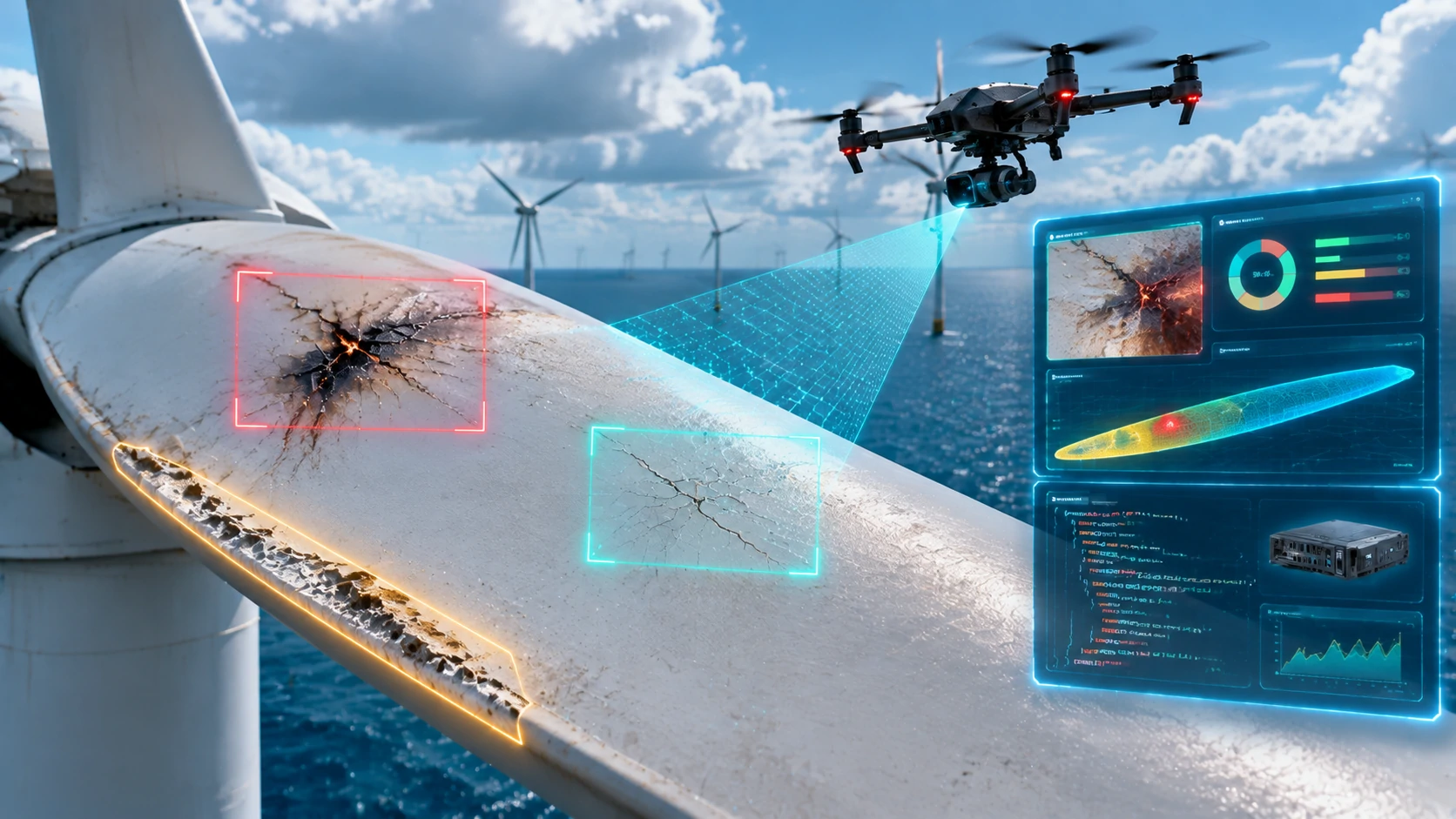
Protecting Multi-Megawatt Assets: Inside WThink’s Wind Turbine Blade Inspection API
Modern utility-scale wind turbines operate in punishing environments. From the salt-spray abrasion of offshore arrays to the freeze-thaw cycles and dust storms of desert wind farms, turbine blades endure continuous mechanical flexing and environmental wear. Over time, seemingly minor surface pitting evolves into deep structural delamination or catastrophic blade failure.
Traditional inspection methods—such as ground-based spotting scopes or rope-access technicians rappelling down rotor blades—are inherently slow, subjective, and dangerous. While autonomous drones have simplified aerial image acquisition, wind farm operators and independent service providers (ISPs) face a severe data bottleneck: processing tens of thousands of high-resolution blade photos per campaign.
To solve this, WThink has introduced its specialized Wind Turbine Surface Damage Detection API. Engineered for seamless integration with drone fleets, edge computing boxes, and enterprise predictive maintenance platforms, this computer vision service automates the identification, classification, and severity scoring of blade and tower surface degradation in real time.
Aerodynamics & Physics: Why Blade Surface Damage Destroys Energy Yield
To understand the economic urgency behind automated inspection, O&M managers must evaluate how microscopic surface imperfections directly degrade aerodynamic efficiency.
1. Leading-Edge Erosion and Boundary Layer Separation
Wind turbine blades are precision airfoils designed to maintain smooth, laminar airflow across their surface. When environmental friction creates localized pitting and surface erosion:
- The surface roughness trips the laminar boundary layer prematurely, causing turbulent airflow.
- Turbulence increases aerodynamic drag while drastically reducing aerodynamic lift.
- Industry research demonstrates that even moderate leading-edge erosion can reduce Annual Energy Production (AEP) by 2% to 5%, with severe pitting leading to power generation losses exceeding 10%.
2. The Structural Progression: From Craze to Delamination
Surface cracks rarely remain static:
Cyclic stress causes hairline cracks in the external polyurethane topcoat and gel coat.
Water penetrates the protective shell, reaching the underlying fiberglass or carbon fiber laminates.
Trapped moisture freezes and expands, tearing apart resin bonds and generating sub-surface delamination (hidden craze).
Centrifugal and aerodynamic forces cause the structural spar cap or trailing-edge bond to split open during high wind shear.
Decoding the 8 Damage Classes of WThink’s Vision Model
Unlike generic object detection models that merely flag “damage,” the WThink algorithm categorizes defects into eight standardized industrial classes to guide targeted O&M remediation:
Corrosion
Oxidative breakdown and metallic degradation, primarily detected on tower flanges, bolts, and nacelle hardware.
corrosionCraze
Visible surface-level hairline cracking across the gel coat shell.
crazeHide Craze
Subtle, low-contrast structural micro-fractures indicating internal laminate stress beneath the outer resin layer.
hide_crazeSurface Attachment
Foreign matter such as biological fouling, bird deposits, or insect accumulation that alters local aerodynamic boundary layers.
surface_attachSurface Corrosion
Localized surface pitting and primer breakdown before structural substrate penetration occurs.
surface_corrosionSurface Injury
Mechanical gouges, foreign object impact damage, or handling tears sustained during installation.
surface_injureSurface Oil
Hydraulic fluid or gearbox lubricant leaks weeping from the nacelle or pitch bearings onto the exterior blade root.
surface_oilThunderstrike
Carbonization burns, receptor pitting, and explosive composite blowout caused by high-voltage lightning strikes.
thunderstrikeAPI Architecture: Connecting Drone Flights to Automated Work Orders
WThink delivers its vision algorithms across a flexible software architecture designed to fit both real-time operational field environments and centralized data warehouses:
1. Edge-Native Processing (Docker & Local SDK)
On offshore crew transfer vessels (CTVs) or remote mountain farms with zero internet connectivity, inspection data cannot be streamed to the cloud. WThink packages the inference engine into containerized Docker images and edge runtime binaries compatible with industrial edge hardware (such as WThink HUBA1, HUBNX, M3X, and RobotEdge units). Technicians can process gigabytes of mission imagery locally within minutes of a drone landing.
2. RESTful Cloud Inference & CMMS Integration
For centralized asset portfolios, images and video feeds are submitted via standard HTTP/HTTPS multipart API endpoints. The structured JSON response returns bounding box coordinates, defect classes, and severity indices. This structured output directly feeds enterprise Computerized Maintenance Management Systems (CMMS) or SCADA platforms, automatically generating maintenance work orders and geotagged photographic work scopes.
Frequently Asked Questions (FAQ)
Q1: Can the algorithm distinguish between harmless dirt and genuine structural cracks?
Yes. The model is specifically trained on extensive field datasets that differentiate surface-level dirt, insect debris, and soot (surface_attach) from true surface micro-fractures (craze and hide_craze). This distinction dramatically reduces the false-alarm rates that plague conventional rule-based image filters.
Q2: How does the API manage variable lighting, blade glare, and rotating blade angles?
WThink’s neural network incorporates aggressive data augmentation—including multi-angle lighting compensation, shadow suppression, and surface glare normalization. It reliably identifies defects whether the blade is captured stationary at horizontal/vertical orientations or during low-light dawn and dusk flight conditions.
Q3: What image resolution and flight distance are recommended for detecting micro-cracks?
For reliable detection of fine hairline crazing and micro-pitting, an image ground sampling distance (GSD) of 0.5 to 1.5 mm/pixel is recommended. Drones equipped with high-resolution full-frame cameras maintaining a standoff distance of 5 to 10 meters from the blade surface typically provide optimal pixel density.
Q4: Can this algorithm be fine-tuned for specialized offshore turbine blades?
Yes. While the baseline model exhibits strong zero-shot generalization across commercial glass-fiber and carbon-fiber rotor blades, WThink supports incremental transfer learning. By training on small batches of site-specific field images (such as unique anti-icing coatings or serrated trailing-edge attachments), our engineering team can provide fine-tuned container weights tailored to your fleet.
Elevate Wind Fleet Reliability with WThink APIs
Preventing catastrophic blade failure begins with spotting microscopic surface flaws before they penetrate structural laminates. By embedding WThink’s Wind Turbine Surface Damage Detection API into your inspection pipeline, wind asset owners, drone service providers, and O&M contractors can convert raw visual inspection footage into actionable, automated maintenance workflows.
Explore model specifications, access API documentation, or schedule an integration consultation with the WThink technical team today.