

Project Background and the Challenges of Dynamic Grid Assets
A high-voltage electricity transmission grid is a highly dynamic infrastructure composed of thousands of steel lattice towers, long-span conductors, and delicate insulator strings. At a major regional grid operator managing a massive 500kV network, maintaining a precise operational and structural baseline was an immense engineering challenge. Power transmission assets are subject to continuous physical and environmental changes, including conductor sag under high electrical loads, steel tower structural shifting under wind shear, and physical insulation degradation. Historically, the utility’s inspection datasets—including optical drone photographs, scattered laser scanning files, and localized thermal readings—were stored in disjointed directories, making it difficult to correlate environmental changes with live electrical and thermal parameters.
Operational Bottlenecks in Disjointed Data Management
This lack of data integration created significant operational bottlenecks for the maintenance teams. When a minor structural shift or a localized hotspot occurred along a remote corridor, engineers had to manually retrieve and compare scattered files to understand the root cause. This manual compilation process was slow and prone to oversight, meaning that subtle, early-stage degradation often went undetected until it escalated into a major equipment failure. Furthermore, without a unified spatial model to track active automated inspections and long-term asset health trends over time, the utility could not conduct accurate predictive calculations regarding remaining component lifetimes, resulting in highly reactive maintenance schedules and high emergency repair costs.
Implementing WThink’s Digital Twin Platform
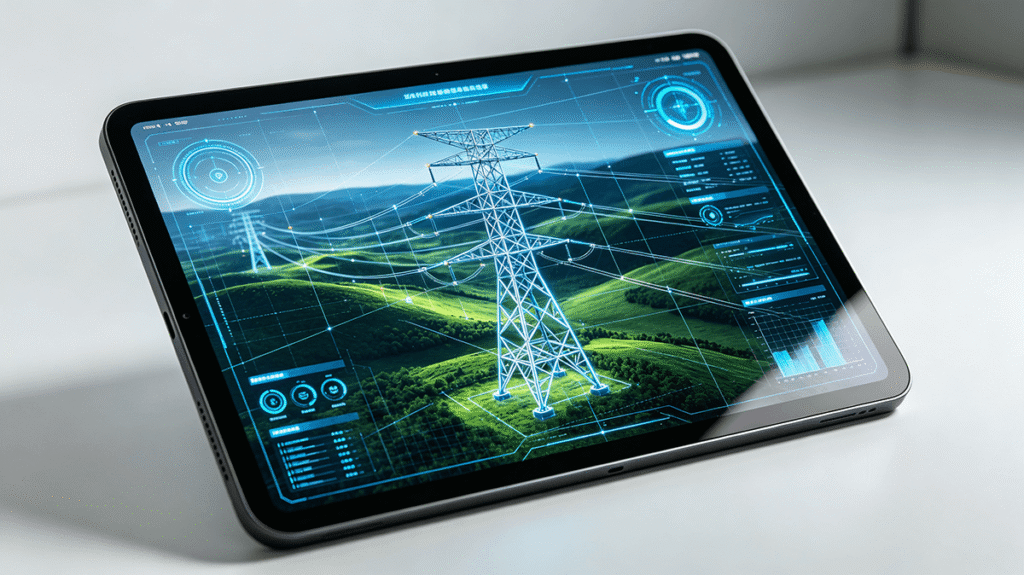
To establish a highly precise, proactive asset management paradigm, the grid operator deployed WThink’s Digital Twin & Data Intelligence platform across its transmission corridors. This advanced solution unifies high-resolution 3D spatial models, geographic information systems, real-time SCADA telemetry, and automated robotic patrol logs into a living, high-fidelity digital replica of the entire physical grid. By continuously matching field-derived sensor data with the virtual asset models, the platform provides the engineering team with real-time operational awareness and predictive intelligence from a single interface.
Multi-Sensor Integration and Automated Robot Patrolling
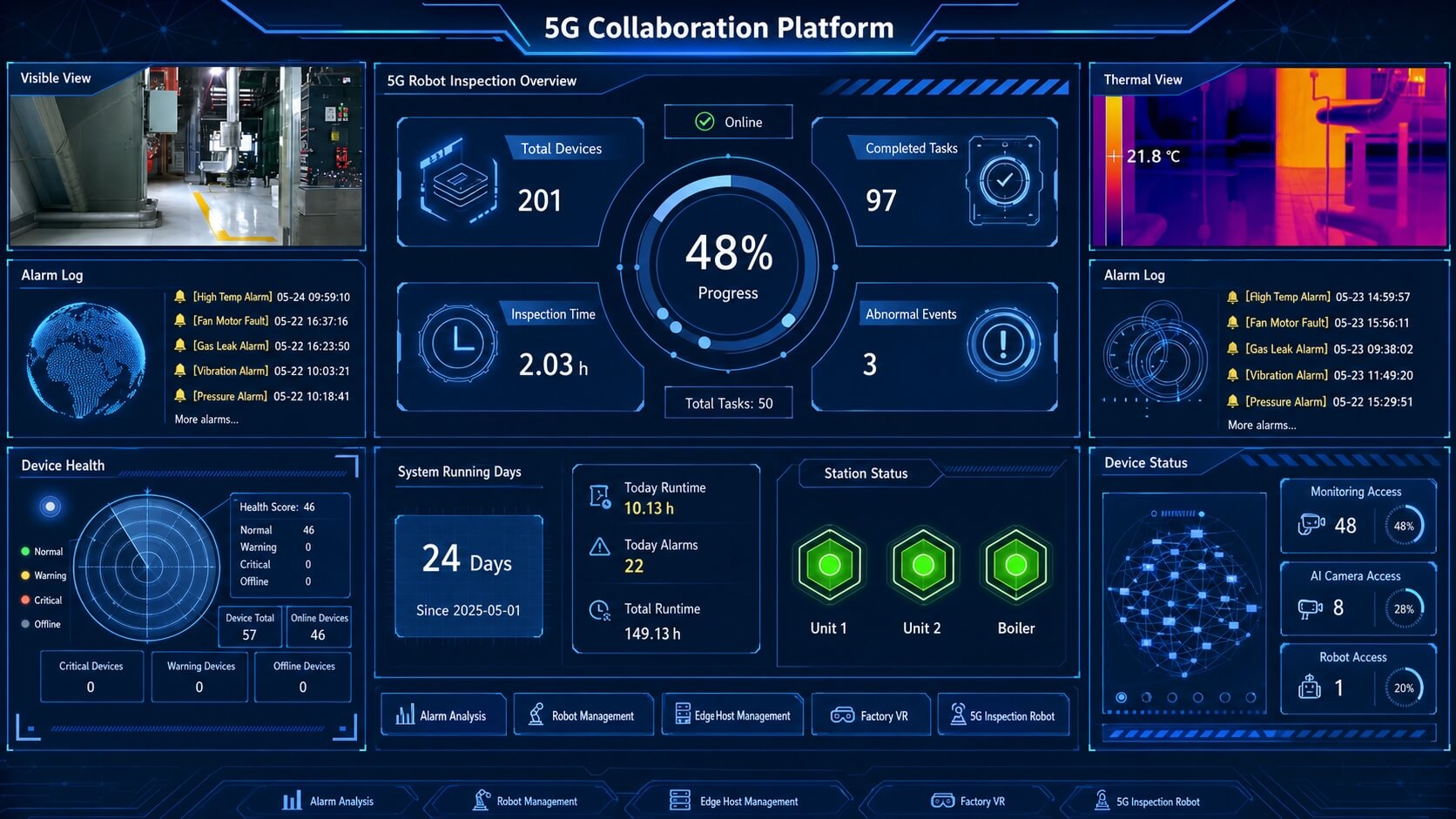
The digital twin platform operates as a centralized data aggregator, continuously importing and visualizing live feeds from across the transmission network. Through the unified dashboard, operators can monitor both “Visible View” optical feeds and “Thermal View” radiometric temperature datasets captured by automated camera systems and track-mounted substation robots. The system’s integrated 5G Robot Inspection module tracks the active progress of automated patrols, showing total online devices, completed tasks, and active runtime statistics. Built-in analytics process these multi-sensor feeds to instantly detect and log abnormal events—such as abnormal vibrations, localized high temperatures, gas leaks, or pressure drops—pinpointing the exact component location on the 3D virtual tower model.
Device Health Assessment and Lifecycle Optimization
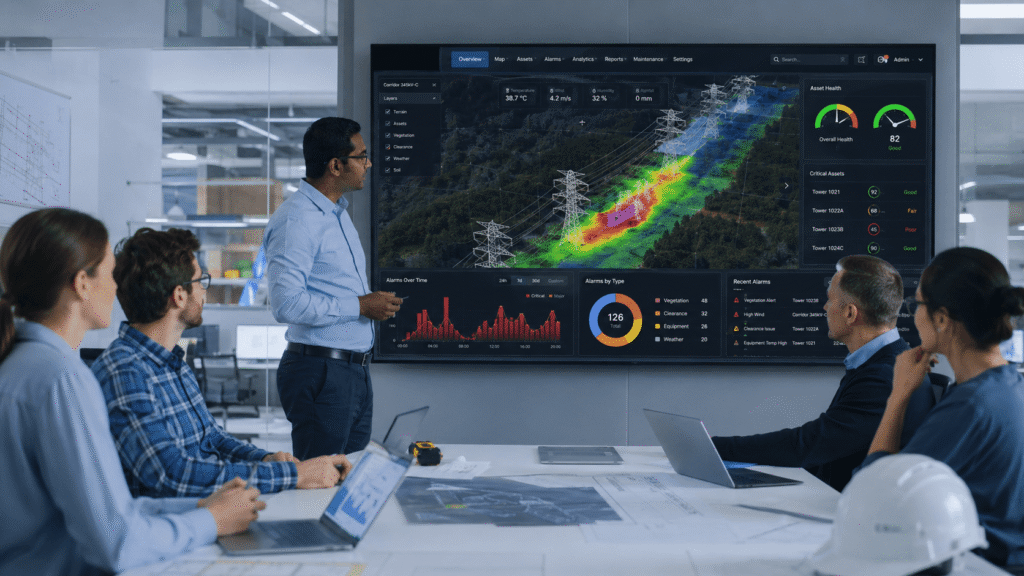
By correlating real-time telemetry with historical inspection data, the platform’s data intelligence engine calculates a dynamic “Device Health” score for all critical assets. This continuous analysis of structural and thermal trends allows the system to identify subtle mechanical wear or insulation degradation long before a physical breakdown occurs. Instead of waiting for a component to fail, grid managers can utilize these predictive insights to schedule targeted, proactive maintenance during planned off-peak hours, optimizing spare parts inventory and significantly reducing emergency repair costs. Ultimately, the implementation of WThink’s Digital Twin & Data Intelligence platform has successfully transitioned the grid utility to a highly reliable, data-driven standard, protecting high-value grid infrastructure and maximizing the lifecycle efficiency of the wide-area transmission corridors.