

Project Background and the Bandwidth Bottleneck
For utility-scale solar farms located in extremely remote or mountainous regions, establishing a fast and reliable network connection is one of the greatest operational hurdles. At a massive regional solar project composed of multiple dispersed generation sites, the operations team relied on costly satellite or low-bandwidth cellular backhaul connections to transmit data back to their regional headquarters. High-resolution optical cameras and thermal sensors on autonomous drones capture gigabytes of visual data during every routine inspection. Attempting to upload this massive volume of raw imagery directly to a centralized cloud server over limited remote networks proved impractical, causing severe transmission delays, frequent connection drops, and exorbitant data subscription costs.
Critical Diagnostic Delays in Remote Sites
The high latency of raw data transmission created a significant lag in the maintenance cycle. Critical electrical and structural failures, such as zero-current strings or severe hotspots, could remain active for days before the headquarters compiled, uploaded, and analyzed the raw inspection footage. This delay in fault detection directly impacted the daily power generation revenue of the facility and increased the risk of permanent equipment damage. To overcome this communication and diagnostic bottleneck, the facility required a hybrid computational model that could process massive visual datasets instantly on-site while maintaining centralized oversight and coordination from the central headquarters.
Deploying WThink’s Cloud-Edge Integrated Architecture
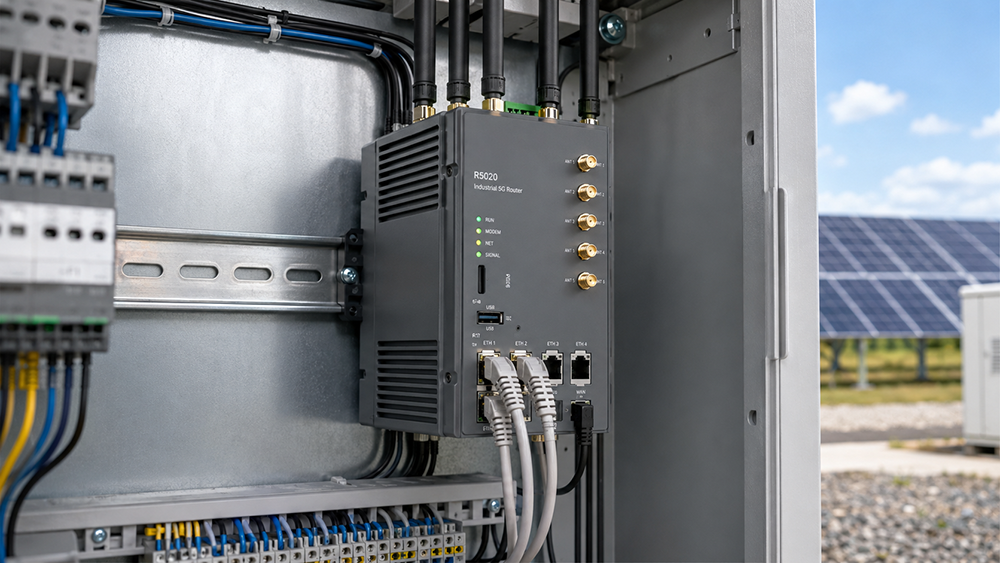
To resolve this bottleneck, the company implemented WThink’s Cloud-Edge Integrated Architecture across all of its remote solar generation sites. This advanced framework deploys high-performance intelligent edge-computing nodes locally within the electrical cabinets of each individual solar facility. These ruggedized edge hosts are designed to operate reliably under extreme outdoor temperatures and dusty environments. Simultaneously, a centralized cloud platform is maintained at the corporate headquarters, serving as the master orchestrator. By dividing the computational workload between local edge nodes and the central cloud, the system eliminates the need to transmit large volumes of raw video and image data across remote networks.
Local Processing and Intelligent Data Filtering
The core operational workflow begins at the edge node deployed at the solar site. As autonomous drones or fixed PTZ cameras capture high-resolution thermal and optical feeds, the local edge node analyzes the video streams in real-time using built-in deep learning algorithms. The edge host performs localized object detection and thermal anomaly analysis, identifying and categorizing specific defects on-site. Once the defects are detected and mapped to their exact coordinates, the edge node filters out the redundant, healthy imagery, compressing the diagnostic results into lightweight XML metadata and tiny cropped alert images. This structured diagnostic data is then transmitted instantly and securely via WThink’s industrial routers to the central cloud platform, reducing network bandwidth usage by over ninety percent.
Centralized Management and Subarray Diagnosis
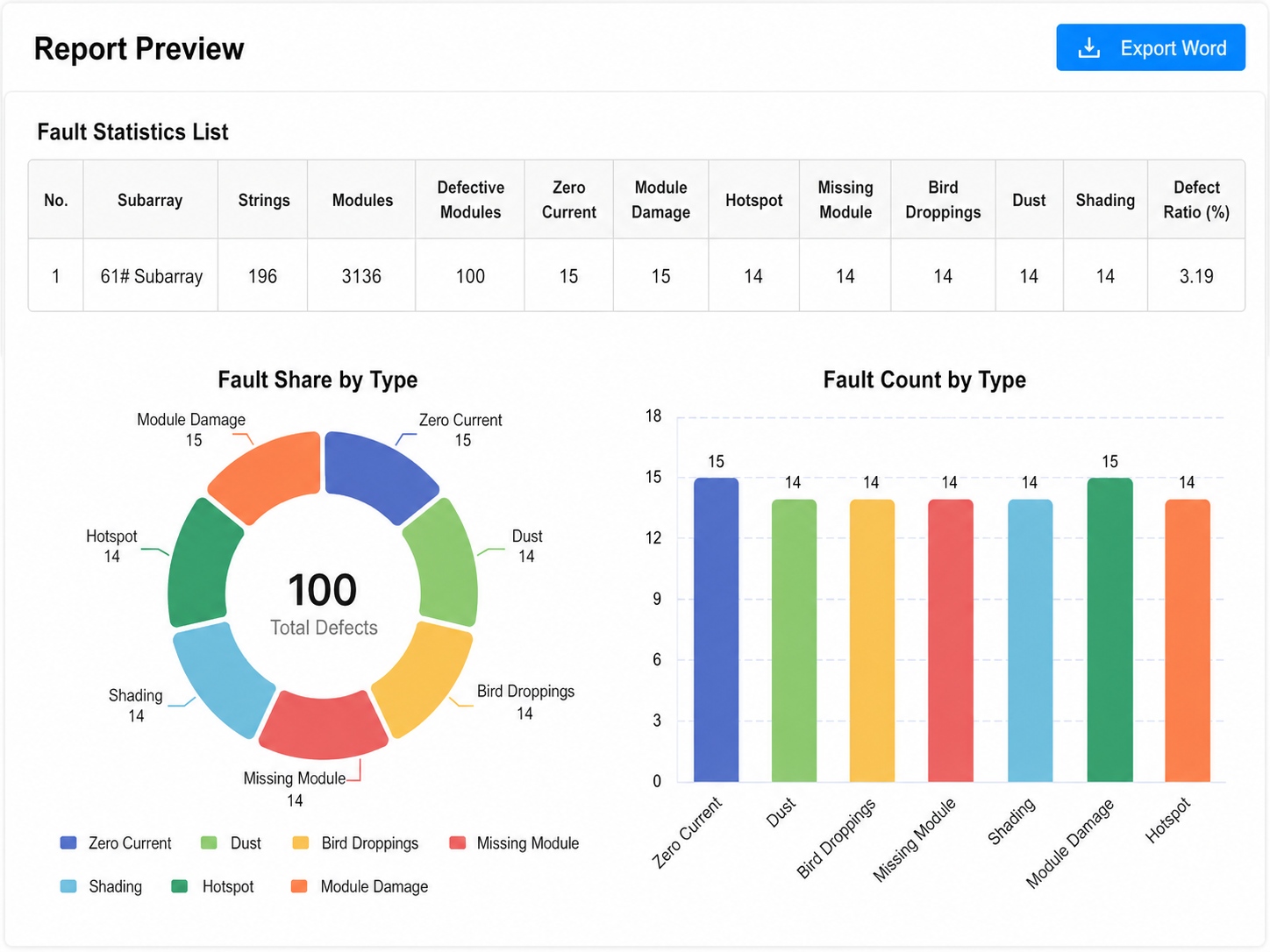
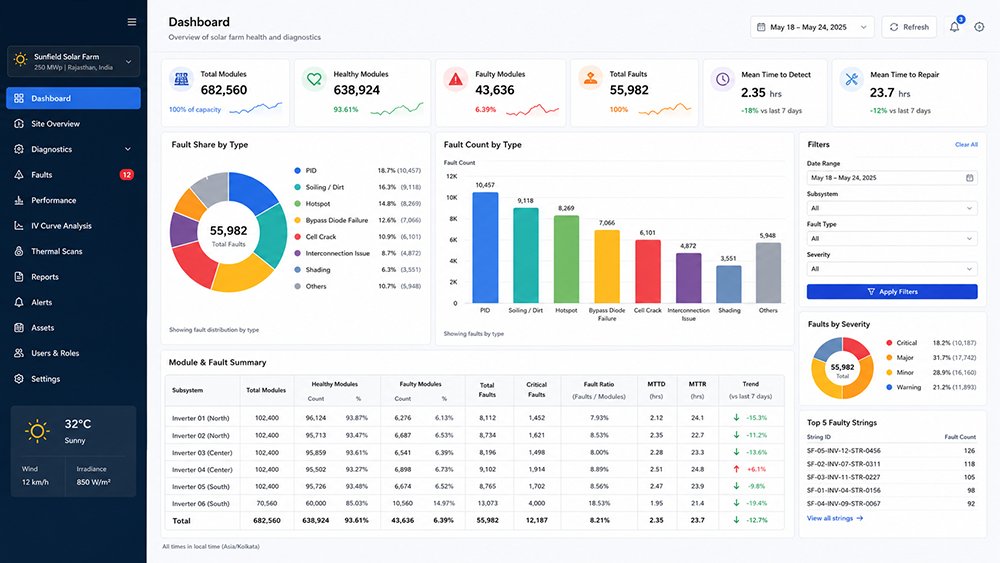
At the corporate headquarters, the centralized cloud platform receives the lightweight metadata from all regional edge nodes and automatically aggregates the information into a comprehensive, multi-site dashboard. Operators can drill down into the performance metrics of specific subarrays, such as Subarray 51#. The cloud dashboard presents clear, visual analytics, including a fault share donut chart and a fault count bar chart, highlighting the exact quantities of issues like module damage, zero-current strings, hotspots, missing modules, bird droppings, dust, and shading. With a total defect ratio immediately calculated and displayed, asset managers can evaluate the precise health of each regional site at a glance, allowing them to coordinate targeted, highly efficient maintenance campaigns across their entire portfolio.
Operational Results and Business Benefits
The deployment of WThink’s cloud-edge integrated architecture has successfully resolved the bandwidth and communication bottlenecks that previously hindered remote solar operations. By shifting heavy visual computation to the edge, the diagnostic latency of critical faults has been reduced from several days to under five minutes. This rapid response capability has allowed maintenance teams to quickly resolve zero-current faults and hotspots, significantly improving overall energy capture and minimizing fire risks. Furthermore, the massive reduction in cellular data transmission has dramatically lowered operational telecommunication costs, demonstrating that a coordinated cloud-edge architecture is a highly practical and scalable approach for modern digital energy infrastructure.