

Project Background and the Challenge of Fragmented Operations
As renewable energy developers rapidly expand their portfolios, managing geographically dispersed solar assets becomes an increasingly complex challenge. A leading clean energy provider with over 600MW of combined capacity across dozens of regional sites struggled with highly fragmented operations and maintenance protocols. Each individual solar plant utilized isolated monitoring systems, independent security setups, and local manual inspection routines. This siloed structure led to inconsistent data collection, delayed fault reporting, and massive administrative overhead. Management at the headquarters lacked a consolidated view of overall system health, real-time power generation metrics, global fault statistics, or the active status of ongoing field maintenance tasks.
Operational Obstacles in Large-Scale Portfolios
Managing multi-site solar portfolios without centralized visibility creates significant operational blind spots. First, because fault reports were generated manually at each local site and compiled weekly, critical module issues like zero-current strings or severe hot spots often went unaddressed for days, leading to compounding power generation losses. Second, coordinating localized maintenance teams was highly inefficient, as dispatch managers had to manually review paper inspection reports before assigning work orders via phone or email. Without a synchronized link between active drone inspections and the field dispatch system, the time gap between identifying a defect and physically resolving it remained unacceptably wide. To maintain profitability and scale their portfolio, the company required a unified digital hub capable of consolidating security, autonomous inspections, and daily operations into a single platform.
The WThink Centralized Operations Solution
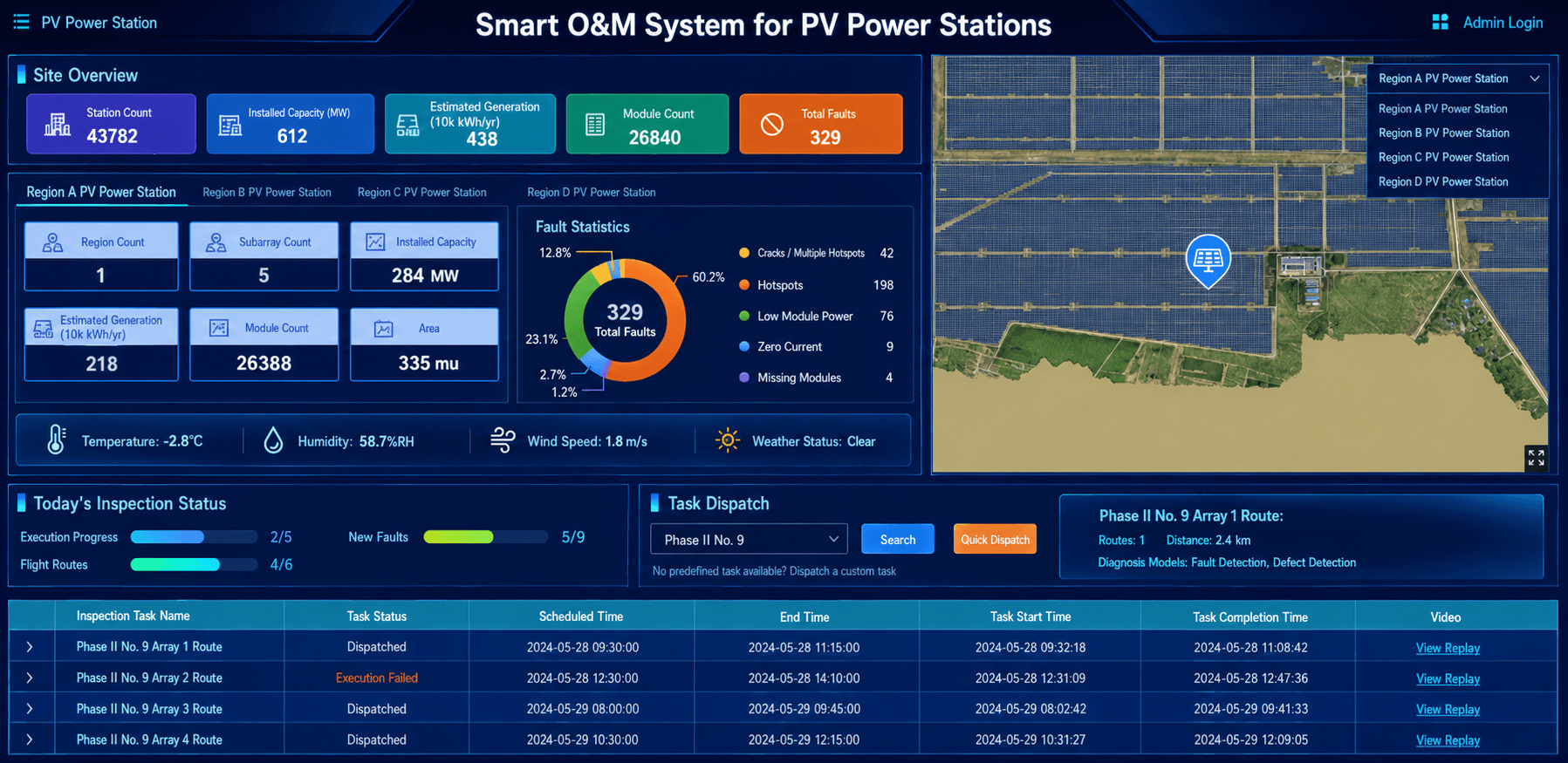
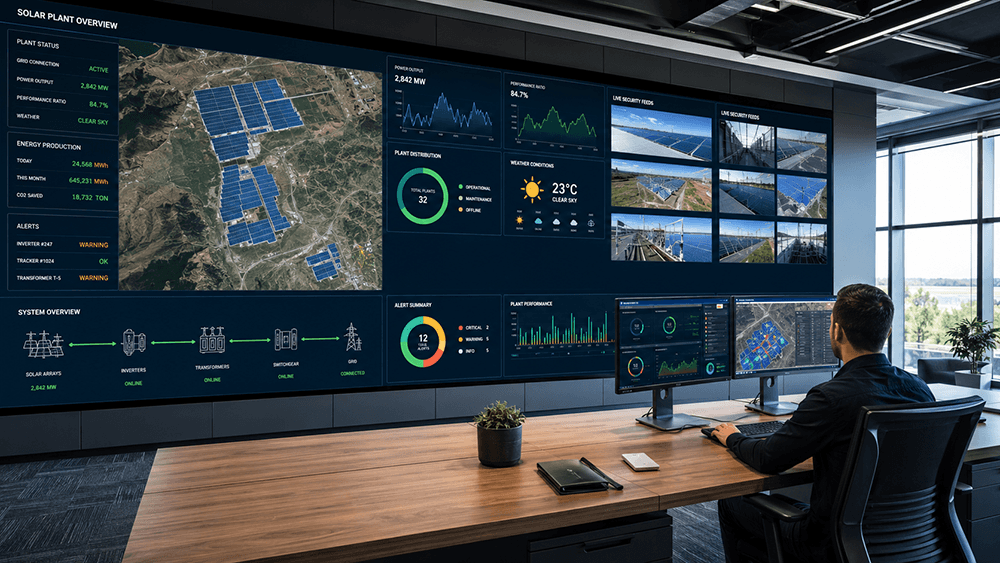
To streamline these operations, the energy provider implemented WThink’s Smart O&M System for PV Power Stations. This comprehensive software platform serves as a unified digital command center, integrating asset telemetry, security feeds, autonomous drone operations, and work order dispatching into one centralized interface. Installed at the company’s regional headquarters, the platform aggregates real-time data streams from multiple distant solar plants (spanning Region A through Region D). Built-in communication protocols continuously retrieve live weather statistics, total active station counts, overall installed capacity, and real-time generation metrics, presenting a complete operational overview to the command center staff.
AI-Driven Analytics and Intelligent Task Dispatching
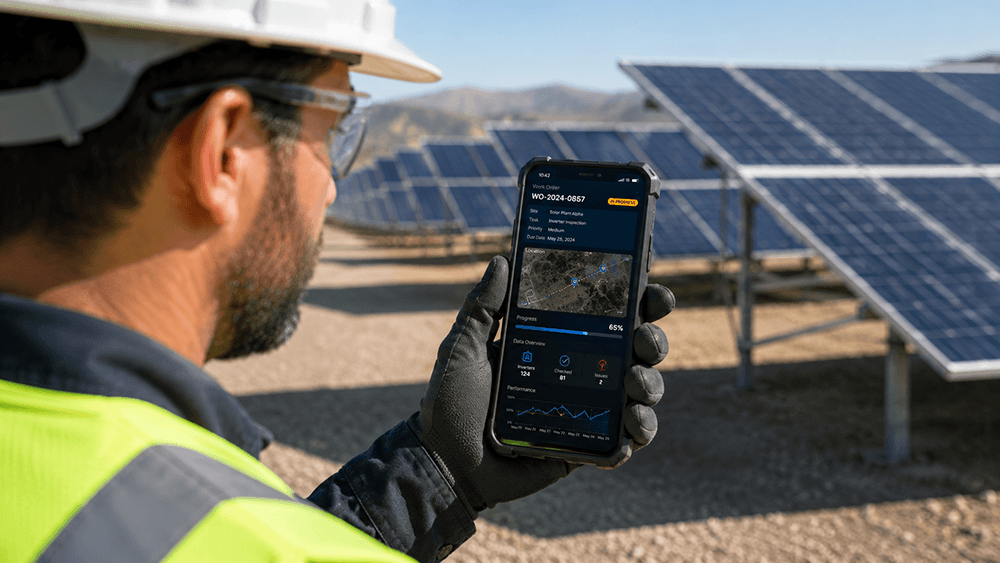
The true power of WThink’s unified platform lies in its ability to turn raw telemetry into automated, coordinated actions. The system’s central map interface displays real-time trajectories of autonomous drone flights and marks exact station coordinates. When an inspection drone or an edge AI safety camera identifies an issue on-site, the diagnostic data is instantly fed into the platform’s central analytics engine. The system automatically categorizes and logs the fault, updating a global pie chart that breaks down defect statistics, such as glass cracks, hotspots, low module power, zero-current strings, or missing modules. Rather than waiting for manual reports, dispatch managers can instantly see live task statuses and scheduled flight routes. Using the platform’s quick-dispatch feature, they can instantly send highly detailed, GPS-tagged work orders directly to the mobile devices of localized field technicians.
Operational Results and Long-Term Scalability
The implementation of WThink’s centralized smart O&M platform has transformed the way the energy provider manages its expansive solar portfolio. By consolidating security, inspection, and operations into a single platform, the company has established a highly efficient, lean management model. The time required to detect, categorize, and assign a panel defect has dropped from weeks to under a single day. Centralized coordination has drastically reduced administrative overhead, eliminated the errors associated with paper-based reports, and ensured a standardized approach to asset protection and maintenance quality across all regions. Ultimately, the transition to unified, data-driven operations has maximized overall energy yields, reduced field maintenance costs, and provided a highly scalable digital blueprint for the company’s future renewable energy expansions.