

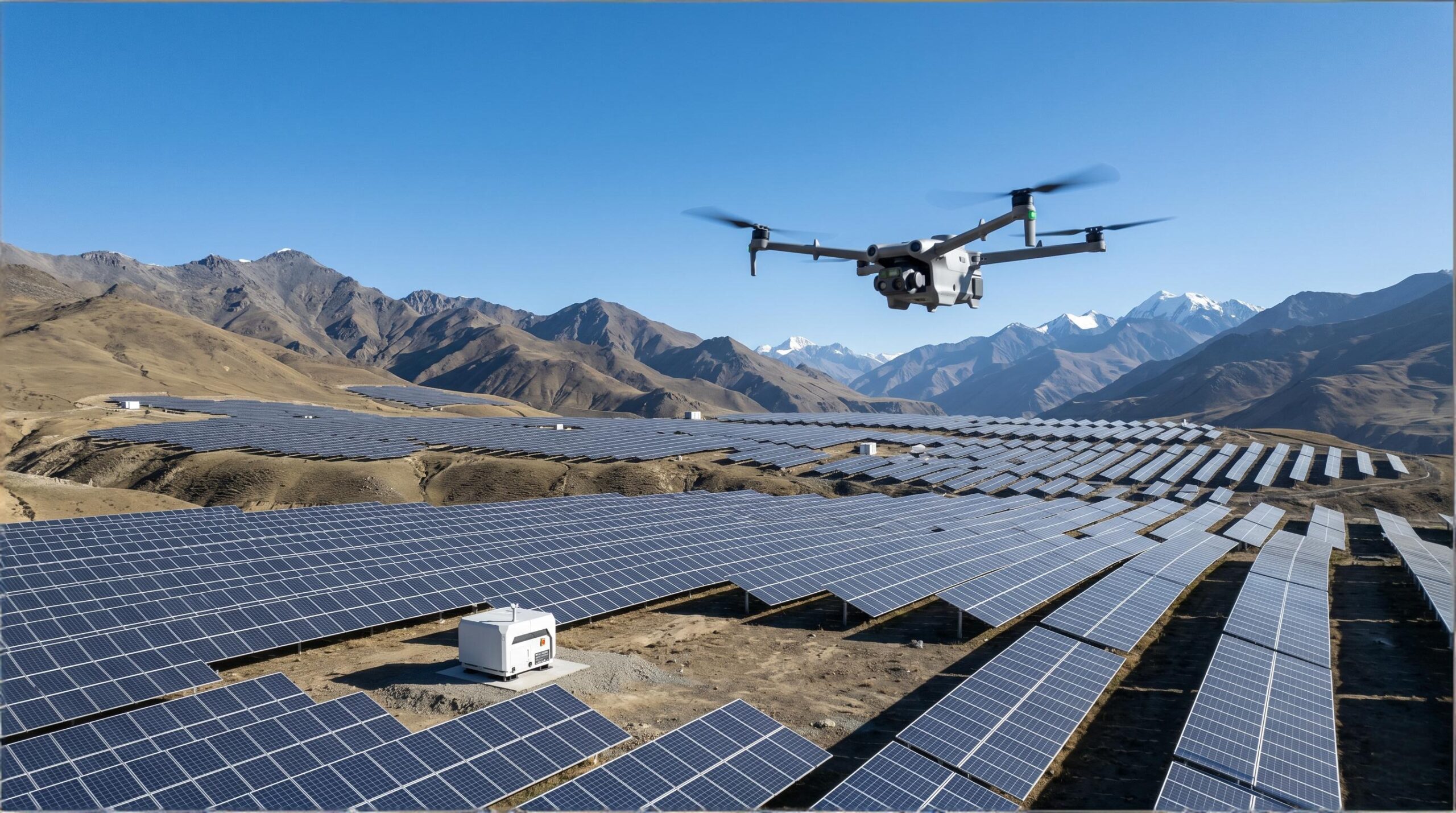
Project Background and Terrain Challenges
This project is situated in a high-altitude, mountainous region characterized by steep terrain, vast spatial dispersion, and harsh, unpredictable weather conditions. Spanning across hundreds of hectares, this 200MW photovoltaic power station features millions of PV modules installed along rugged mountain ridges. Traditional manual inspections at this facility faced severe limitations. Technicians had to traverse treacherous slopes on foot, making comprehensive inspections extremely slow, physically exhausting, and highly hazardous. Furthermore, during unexpected weather events, conducting rapid emergency damage assessments was nearly impossible.
Key Operational Obstacles
The steep mountain slopes and high altitudes made traditional foot-patrols highly dangerous for maintenance staff, especially during winter months when snow and ice covered the access paths. Because of these severe terrain and labor constraints, a full-site inspection took several weeks to complete. This long inspection cycle meant that critical equipment defects, such as hot spots, diode failures, and micro-cracks, often went undetected for prolonged periods, causing significant power losses. Additionally, after severe storms or wind events, identifying the exact location of damaged strings manually was a slow process that further delayed recovery efforts.
The WThink Integrated Solution
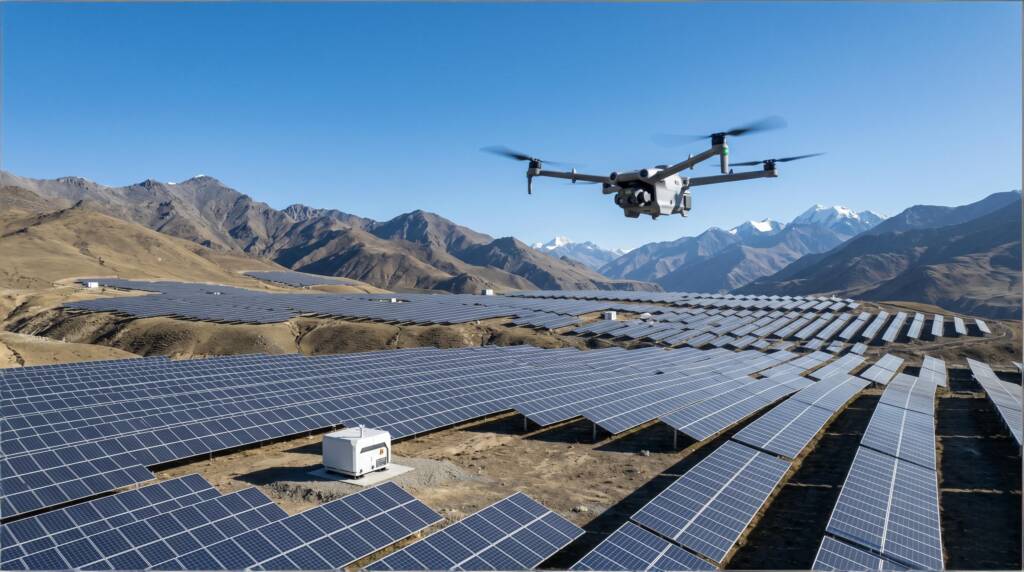
To overcome these challenges, WThink implemented an end-to-end Autonomous Drone and Robot Intelligent Inspection System designed to operate continuously with minimal human intervention. The system relies on weatherproof smart drone docking stations strategically deployed across the solar farm. These fully automated docks house, recharge, and protect industrial drones, operating reliably even under extreme mountain temperatures and high winds. Utilizing high-precision 3D digital twin maps of the terrain, the drones fly autonomously along pre-programmed, terrain-aware flight paths to maintain a consistent altitude above the PV panels. Equipped with high-resolution optical and thermal infrared sensors, the drones capture detailed dual-light imagery during their patrols. This data is transmitted in real-time via WThink’s robust industrial communication terminals to a centralized cloud-edge collaborative AI platform for automated analysis.
Workflow Integration and Automated Analysis
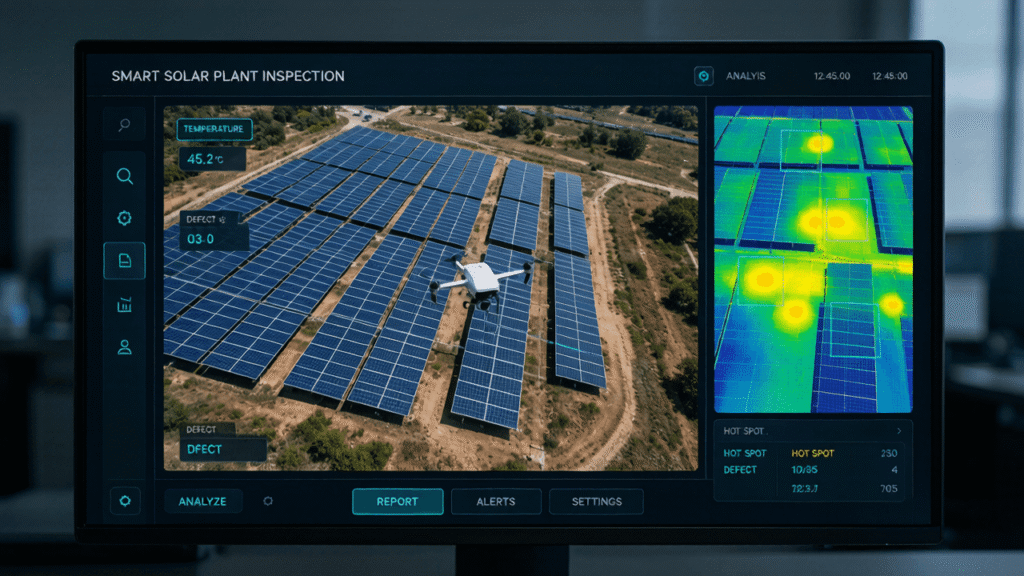
The inspection workflow operates fully automatically without requiring any pilot on-site. The smart docking station opens its canopy at scheduled intervals, allowing the drone to take off, execute a systematic grid patrol of the designated solar arrays, and return to the dock for automated precision landing and rapid charging. In the event of a sudden storm or unexpected grid anomaly, operators at the centralized control center can initiate a one-click emergency flight to quickly assess structural damage. Once the drone captures the thermal and high-definition imagery, the WThink Smart Inspection Platform automatically processes the raw data. The platform’s specialized AI algorithms quickly identify thermal anomalies such as hot spots and string-level outages, alongside physical issues like dust accumulation and cracked glass, mapping each defect to its exact GPS coordinates.
Operational Results and Business Value
The transition from manual patrols to WThink’s autonomous drone inspection system has significantly improved operational efficiency and safety at the PV power station. The entire site inspection cycle has been reduced from several weeks of intensive manual labor to under three hours of fully automated flight and data processing. By eliminating the need for technicians to scale steep mountain ridges, on-site safety hazards have been virtually eliminated. The automated detection system provides highly consistent and precise diagnostic reports, allowing the maintenance team to target and resolve defects immediately. Ultimately, the early identification of hot spots and rapid recovery after storms have stabilized the energy output of the facility, proving that automated edge-intelligence is a highly effective approach for modern utility-scale solar plants.