

Project Background and the Invisible Threat
At utility-scale solar farms, maintaining maximum power generation efficiency requires constant vigilance over millions of individual photovoltaic modules. In a recently optimized 150MW utility-scale solar facility, operators faced a compounding drop in total energy output that could not be easily traced through traditional monitoring systems. While traditional SCADA systems could flag a drop in power generation at the inverter or combiner box level, they lacked the resolution to pinpoint which specific panel or cell was failing. This limitation left the operational team with the monumental task of manually testing thousands of individual panels. The primary culprits behind such energy losses are invisible to the naked eye, consisting of localized thermal anomalies, micro-cracks, bypass diode failures, and subtle dust or soil shading.
The Limitations of Manual Diagnoses
Traditional manual testing methods are not only slow but also introduce significant operational downtime. Technicians must physically disconnect strings and use handheld thermal cameras or curve tracers to find faults, a process that is highly inefficient and prone to human error. Moreover, because manual inspections are conducted infrequently, minor issues like localized hot spots can escalate over time. When a PV cell is shaded or cracked, it ceases to generate power and instead begins to consume energy, acting as a resistor. This resistance causes the cell’s temperature to rise rapidly, creating a hot spot that can permanently damage the panel structure, accelerate degradation of surrounding modules, and in severe cases, present a serious fire hazard.
Deployment of WThink’s Intelligent Detection System
To address this critical diagnostic gap, the facility deployed WThink’s advanced AI-Powered PV Defect Detection solution. This system integrates high-resolution thermal infrared and visible-light optical payloads with edge-computing AI hardware and the Hubble smart monitoring platform. Instead of relying on manual spot-checks, the system processes high-frequency aerial imagery captured during routine autonomous drone flights. WThink’s specialized computer vision models are trained to perform multi-spectral analysis, correlation-checking, and spatial thermal mapping in real-time. By continuously overlaying thermal temperature signatures with visible-light optical frames, the system can instantly distinguish between harmless temporary reflections and actual, high-risk physical panel defects.
Advanced AI Diagnostics and Defect Categorization
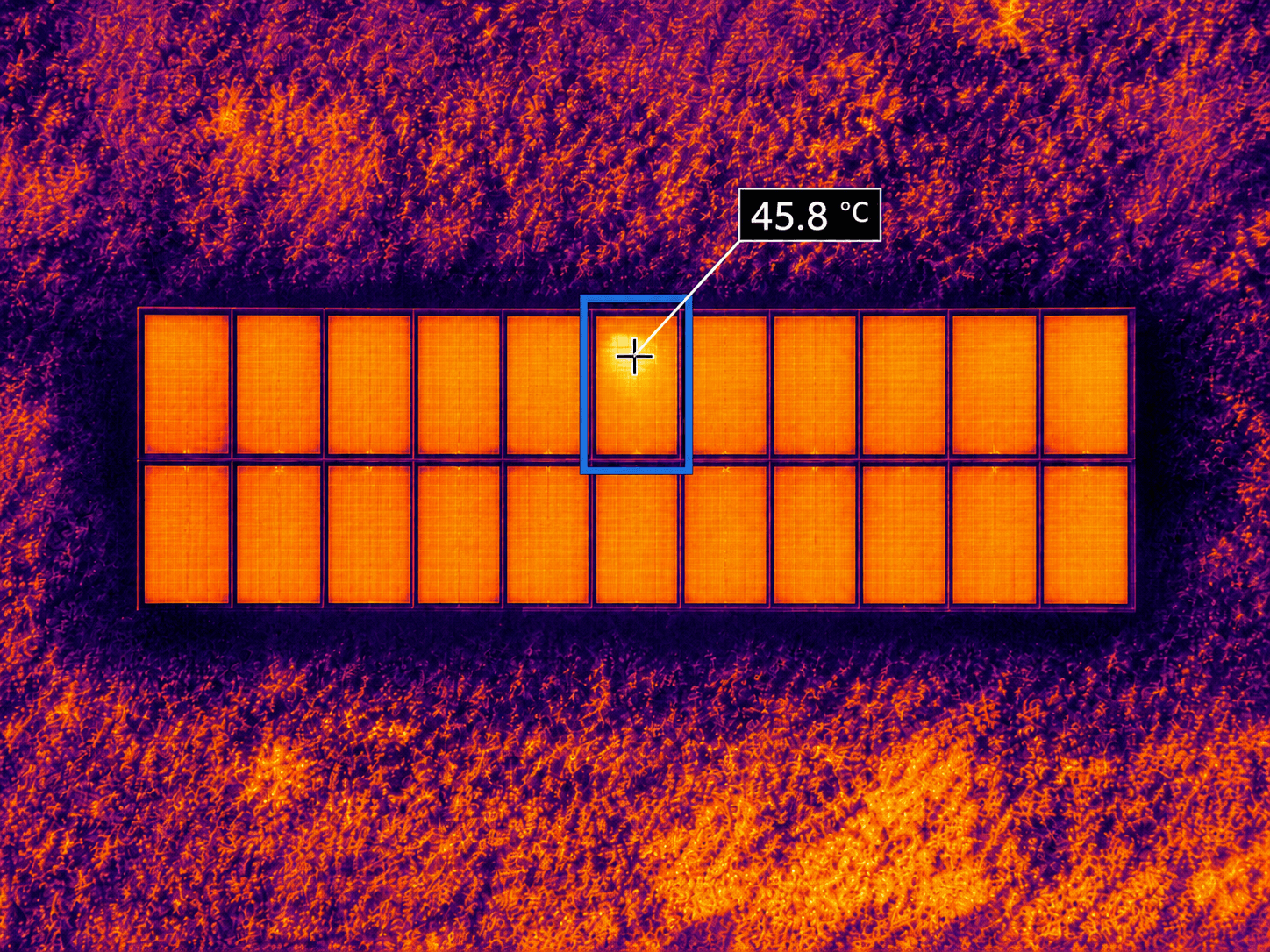
The core strength of the WThink solution lies in its intelligent image analysis engine, which automatically categorizes detected anomalies according to their thermal and visual signatures. When the system detects a temperature spike, such as a localized cell reaching over forty-five degrees Celsius while surrounding cells remain cool, the AI instantly flags it as a hot spot. It then correlates this temperature data with the visible-light channel to determine the root cause, such as heavy dust accumulation, bird droppings, or physical cracks. Furthermore, the AI can recognize complex electrical faults, such as a single hot cell indicating a bypass diode failure, or an entire string showing uniform elevated temperatures which points to an open circuit or junction box issue. Each flagged anomaly is immediately assigned a severity level, and its exact geographical coordinates are calculated and sent to the central asset management system.
Operational Results and Asset Protection
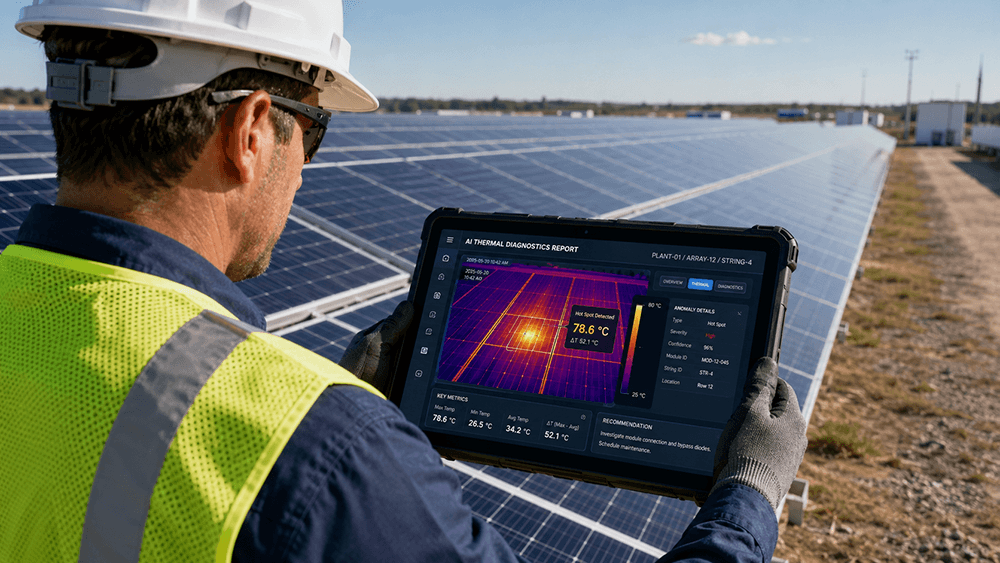
The implementation of WThink’s AI-powered defect detection system has transformed the maintenance paradigm of the 150MW facility from a reactive cycle to a highly precise, predictive model. By automating the analysis of thousands of aerial thermal images, the system successfully identified and mapped hundreds of localized hot spots, diode failures, and shading issues that had previously gone unnoticed. Resolving these hidden defects helped the plant recover significant lost generation capacity and prevented localized panel burnouts. Additionally, the maintenance dispatch workflow was streamlined, as technicians no longer needed to spend days hunting for faults, instead receiving exact GPS locations and diagnostic details directly on their mobile devices. Ultimately, the integration of advanced computer vision has protected the physical integrity of the solar assets and ensured a stable, optimized return on investment for the facility operators.