Zero-Blindspot Worker Safety: Inside WThink’s Reflective Vest Detection API
In container freight stations, rail yards, and heavy manufacturing workshops, industrial forklifts and overhead cranes operate in close proximity to ground personnel. Under poor ambient lighting, dusk, or heavy rain, a pedestrian worker without high-visibility clothing becomes virtually invisible to heavy equipment operators. According to international occupational safety records, struck-by and caught-in-between hazards account for a massive percentage of severe job-site injuries.
While regulatory agencies mandate the continuous wearing of High-Visibility (Hi-Vis) safety apparel, enforcing compliance is an uphill battle for safety officers. Traditional spot-checks are intermittent, and manual CCTV monitoring cannot keep pace with hundreds of moving personnel across complex multi-hectare yards.
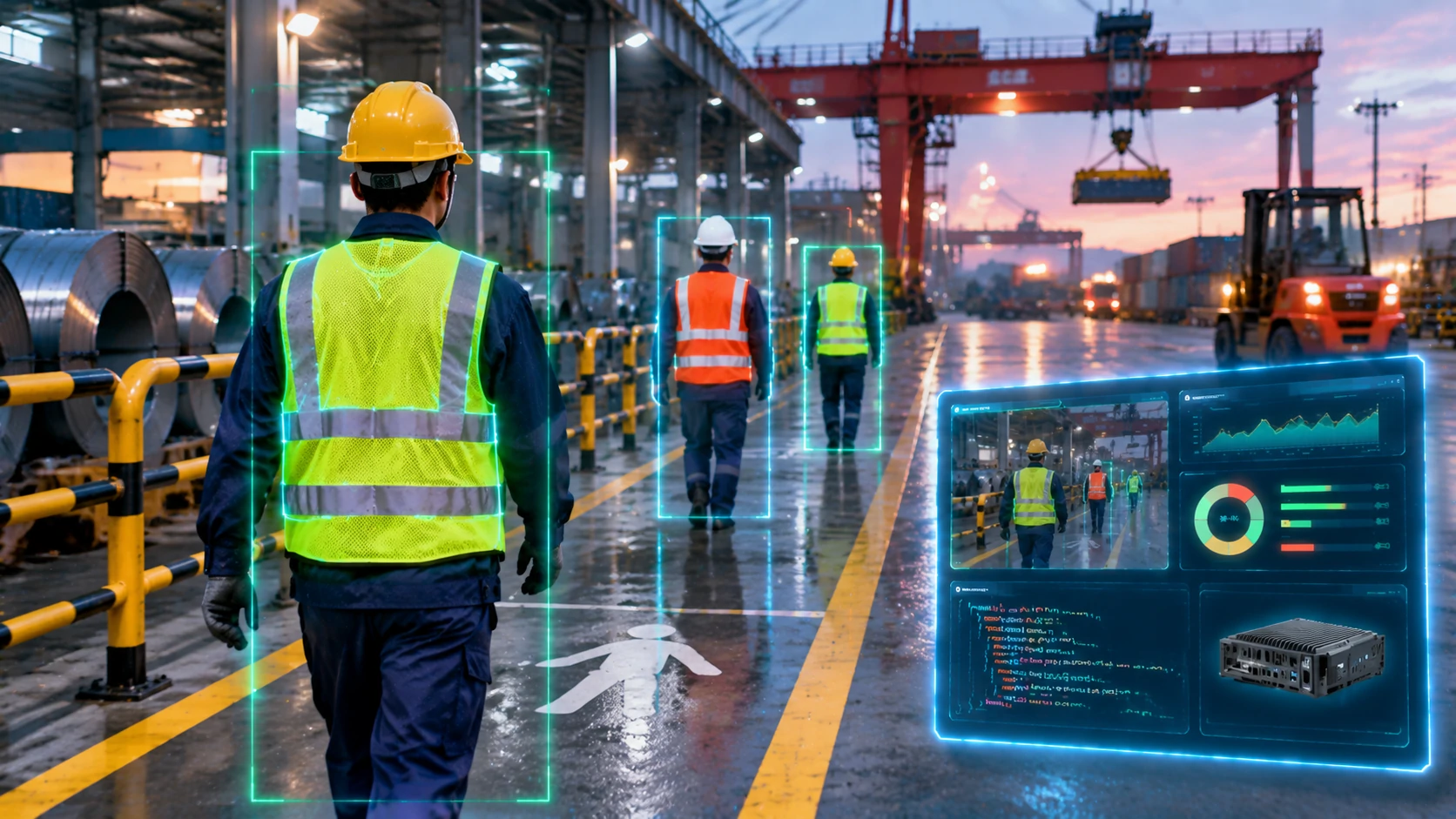
To solve this, WThink provides its specialized Reflective Vest Detection API. Operating as an intelligent computer vision service, this algorithm ingests live RTSP camera feeds and inspection snapshots, automatically verifying whether personnel are wearing compliant high-visibility garments in real time.
Tech Explainer: The Optics of Hi-Vis Garments & The Vision AI Challenge
To understand how vision AI identifies a safety vest, engineers must understand the optical science behind high-visibility workwear—and why conventional computer vision models often fail in the field.
1. The Physics of High-Visibility Apparel
Certified safety apparel (governed by standards such as ISO 20471 or ANSI/ISEA 107) relies on two distinct optical components:
- Fluorescent Background Material: Pigments in fluorescent yellow-green or orange-red absorb invisible ultraviolet (UV) sunlight and re-emit it as visible light, creating intense luminance contrast during daylight, fog, or twilight.
- Retroreflective Tape: Micro-glass beads or micro-prismatic vinyl bands engineered to reflect light directly back toward its original source (such as vehicle headlights or industrial floodlights) with minimal scattering.
2. The Camera Sensor “Blooming” Dilemma
When an industrial floodlight or vehicle headlamp illuminates retroreflective tape at night, the reflected light bounces straight into the camera lens aperture. This triggers sensor pixel blooming—an extreme, localized exposure saturation where the retroreflective band appears as a washed-out, glowing white streak that obscures the worker’s torso.
Basic object detection models frequently misinterpret this saturated bloom as glare, background lighting, or overexposed machinery. WThink’s vision engine solves this through extensive data augmentation. Trained across diverse exposure ranges, the model identifies the distinctive contrast boundaries between the fluorescent fabric and the high-lux retroreflective tape, reliably confirming compliance even under direct headlight flare.
Core Performance Capabilities of WThink’s Algorithm
Trained on 20,000+ Real-World Industrial Samples
The baseline model generalizes across heavily soiled vests, faded fluorescent pigments, unzipped workwear, and varied worker postures (crouching, climbing ladders, operating machinery).
Discrimination Between Uniforms and Everyday Jackets
The algorithm does not simply trigger on bright colors. It specifically analyzes the spatial ratio of fluorescent body coverage and the presence of horizontal/vertical retroreflective striping, avoiding false alarms from casual bright raincoats or yellow shirts.
Edge-Native Architecture
Designed for low-power silicon, the containerized model executes high-throughput inference on NVIDIA Jetson, Rockchip (RK3588), and dedicated WThink hardware (including HUBA1, HUBNX, M3X, and RobotEdge units).
Dynamic Spatial Density Analytics
In addition to single-target compliance, the API calculates worker clustering and regional density, identifying when personnel congregate dangerously close to active loading cranes or high-voltage switchgear.
Practical Integration: From Camera Pixels to Automated Safeguards
WThink delivers its vision capabilities through standardized interfaces that plug directly into existing operational technology (OT) infrastructure:
1. Zero-Bandwidth Edge Video Ingestion
Existing outdoor dome or bullet IP cameras stream 1080p or 4K video via RTSP into an on-site WThink edge computing gateway. By processing video frames locally within the plant’s LAN, high-bandwidth streams never leave the facility, maintaining data sovereignty and reducing network overhead.
2. Event-Driven Actionable Automation
When a worker enters a designated hazardous zone without a certified reflective vest, the API emits a lightweight JSON webhook within milliseconds, triggering automated controls:
- Pedestrian Gate Lockout: Interlocking with access turnstiles to block entry to high-risk zones until high-vis clothing is put on.
- Audio-Visual Warning Beacons: Activating localized strobe beacons or directional speakers (“Caution: Reflective vest required in loading lane”).
- Forklift Telematics Warning: Pushing spatial proximity alerts to onboard vehicle terminals when a non-compliant pedestrian enters a forklift operating aisle.
- EHS Audit Records: Automatically saving timestamped violation crops to the central safety management dashboard to track recurring compliance trends.
Frequently Asked Questions (FAQ)
Q1: Can this algorithm detect reflective vests in complete darkness?
Yes, provided the surveillance camera operates with infrared (IR) night-vision illumination or ambient perimeter lighting. The retroreflective bands illuminate prominently under IR wavelengths, enabling the model’s specialized night-mode weights to verify striping patterns and body contours.
Q2: How does the algorithm handle unzipped or partially covered vests?
WThink’s neural network evaluates the visible surface area of both the fluorescent background and the reflective bands. If an unzipped vest hangs loosely to the sides, obscuring the front retroreflective crossbands, the system flags a “partial/improper compliance” event for inspection.
Q3: What is the recommended camera mounting angle and distance for high accuracy?
For perimeter security and yard monitoring, cameras mounted at heights between 3 to 7 meters with a downward depression angle of 30 to 45 degrees deliver optimal perspective geometry. A target person height of at least 120 pixels ensures reliable detection.
Q4: How does this API differ from WThink’s multi-class PPE detection model?
While WThink’s broader PPE Detection API concurrently verifies multi-colored hard hats, masks, and vests for general factory floors, this dedicated Reflective Vest Detection API provides deeper, specialized classification for outdoor high-traffic environments—focusing heavily on retroreflective stripe geometry, fluorescent color fidelity, and extreme lighting resilience.
Protect Your Workforce with WThink Vision APIs
Preventing industrial vehicle collisions and struck-by accidents begins with guaranteed high-visibility compliance. By integrating WThink’s Reflective Vest Detection API into your security cameras, mobile inspection robots, or enterprise safety software, facility managers and system integrators can deploy an automated, 24/7 vision guardian across every operational yard.
Access API endpoints, download containerized deployment packages, or consult with the WThink engineering team to start your pilot integration today.