Proactive Fire Risk Mitigation: Inside WThink’s AI Smoking Detection API
A single cigarette butt or open ignition flame can cause catastrophic explosions in fuel storage tank farms, chemical loading docks, or thermal power coal yards. Despite clear “No Smoking” mandates and severe regulatory penalties, covert smoking in stairwells, maintenance corridors, and secluded yard corners remains a persistent safety violation.
Conventional facility protection relies on photoelectric or ionization ceiling smoke alarms. However, these sensors require dense smoke plumes to physically reach the sensor chamber—meaning they act as post-disaster warnings rather than pre-combustion prevention. Furthermore, relying on human security guards to monitor dozens of split-screen surveillance feeds inevitably leads to observer fatigue and missed violations.
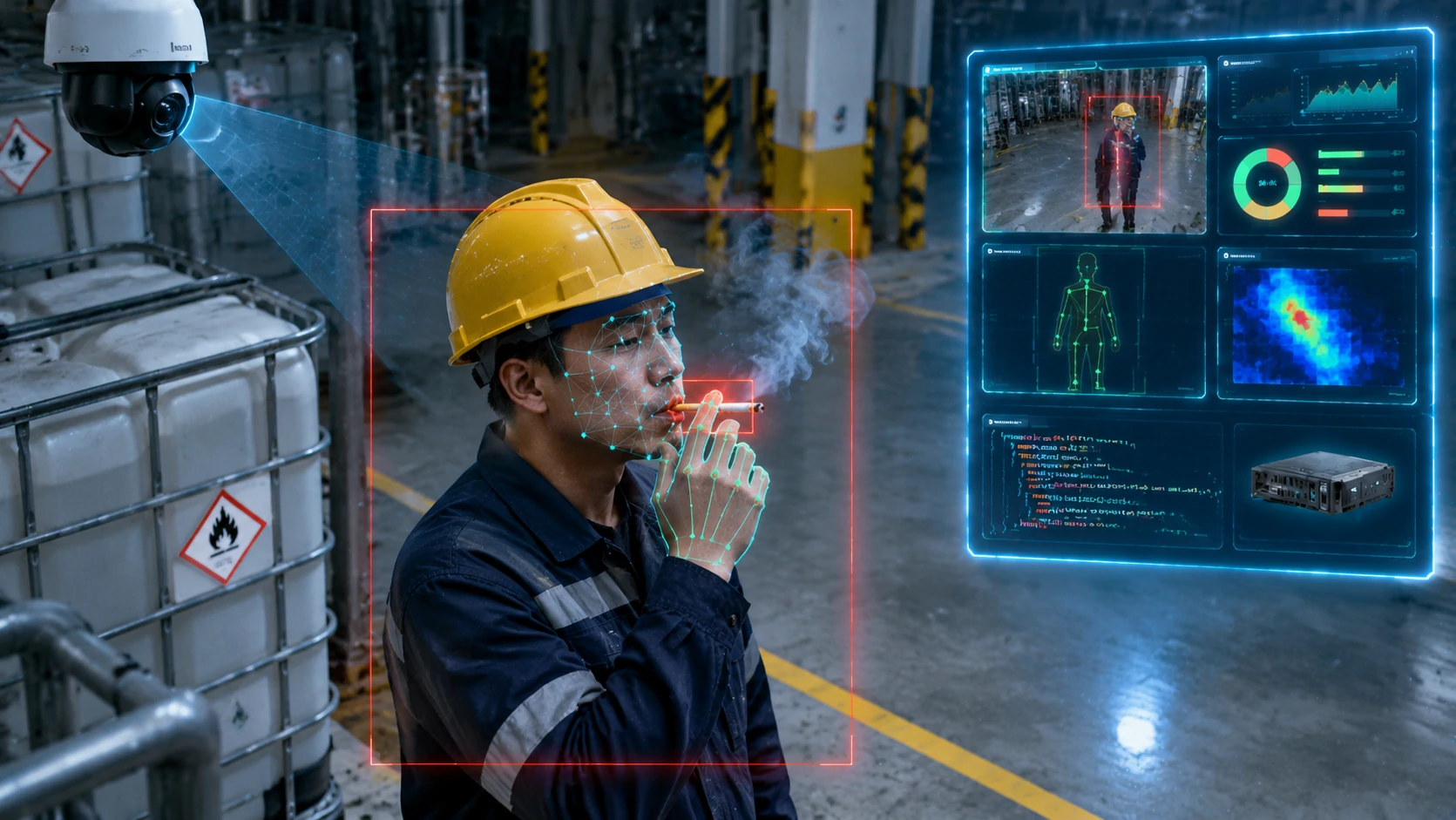
To eliminate this hazard at the source, WThink provides its enterprise-grade Smoking Detection API. By embedding deep learning vision analytics into existing IP camera feeds and edge processing appliances, this algorithm service automatically detects cigarettes, hand-to-mouth smoking gestures, and localized combustion smoke in real time.
Tech Explainer: Why Smoking Detection Is a Complex Vision Challenge
From an algorithmic standpoint, identifying a smoking event is far more intricate than standard vehicle or person detection. A cigarette cylinder is only a few millimeters in diameter and often occupies fewer than 15 pixels on a standard 1080p surveillance feed. If a system relies purely on finding a “white stick,” everyday activities—such as biting fingernails, eating a snack, drinking from a mug, or talking on a smartphone—generate an unbearable volume of false positive alarms.
To achieve industrial-grade reliability, WThink’s vision engine deploys a dual-stage spatial-temporal detection architecture:
1. Stage 1: Skeletal Pose Estimation & Spatial Gating
The neural network first tracks human posture keypoints across the head, shoulders, elbows, and wrists. When the spatial distance between the wrist keypoint and mouth keypoint narrows below a dynamic threshold, the algorithm triggers a high-attention localized Region of Interest (ROI) around the lower face and hands.
2. Stage 2: Micro-Object & Ember Feature Extraction
Within this localized sub-region, specialized convolutional layers search for fine-grained multi-spectral features:
- The cylindrical geometry and aspect ratio of a cigarette.
- Localized combustion luminance (the glowing orange ember).
- Dissipating micro-plumes of aerosol smoke curling upward from the hand or mouth.
3. Temporal Sequence Filtering (The Anti-False Alarm Engine)
A fleeting touch of the face is not a smoking event. WThink’s algorithm processes image sequences across a sliding temporal window (e.g., 2 to 4 seconds). The API evaluates whether the hand-to-mouth motion exhibits the periodic, sustained dwelling pattern characteristic of inhaling, filtering out benign activities like yawning or scratching one’s nose before an alarm is issued.
Core Performance Capabilities of the WThink Algorithm
Extensive Pre-Training Baseline
Pre-trained on a corpus of more than 22,000 real-world operational images, the baseline model accounts for diverse body postures (standing, sitting, crouching behind machinery) and lighting shifts.
Rapid Inference on Edge Silicon
Optimized for lightweight execution, the model runs efficiently across NVIDIA Jetson, Rockchip (RK3588), and dedicated WThink edge appliances (such as HUBA1, HUBNX, M3X, and RobotEdge units).
Multi-Input Flexibility
The service seamlessly ingests continuous RTSP/RTMP surveillance streams, mobile inspection video feeds captured by robotic ground rovers, or batches of static site photos.
Continuous Incremental Fine-Tuning
If a facility introduces unique employee work uniforms, thick winter gloves, or specialized respiratory PPE, the model supports transfer learning using a small set of customer field images to maintain pinpoint accuracy.
Deployment Architecture: From RTSP Ingestion to Instant Interlock
WThink’s algorithmic platform operates across three synchronized execution layers to ensure data privacy and zero network congestion:
Step 1: Local Stream Decimation
On-premise IP cameras feed continuous RTSP video into a local edge computing gateway. To maximize hardware efficiency across 8 to 16 video channels simultaneously, the gateway samples frames at an optimized rate (e.g., 5 to 10 FPS), keeping computational headroom open.
Step 2: Edge Inference & Zero-Cloud Latency
The inference engine processes video frames locally within the plant’s private LAN. Raw high-bandwidth video never leaves the facility, satisfying stringent corporate cybersecurity and privacy compliance policies.
Step 3: Event-Driven API Dispatch
Upon confirming a smoking event, the edge gateway emits a standardized JSON webhook to upstream systems:
- Audio-Visual Warning: Activating on-site strobe lights or automated voice warnings (“Warning: Smoking detected in restricted hazardous zone”).
- Security Console Pop-up: Pushing live video feeds and timestamped snapshots directly to the central security dashboard.
- Safety Ledger Logging: Registering the incident in the plant’s EHS (Environmental Health and Safety) compliance ledger for review and root-cause accountability.
Frequently Asked Questions (FAQ)
Q1: Can this algorithm detect electronic cigarettes (vaping) in addition to traditional tobacco?
Yes. Because the primary detection pipeline monitors hand-to-mouth behavioral trajectories combined with localized vapor plumes, the algorithm flags both traditional combustible cigarettes and modern electronic vape devices.
Q2: What camera mounting height and resolution are required for effective detection?
For optimal accuracy, a camera resolution of 1080p (2MP) or 4K is recommended. The person’s upper torso and face should occupy at least 150×150 pixels within the frame. Cameras mounted at heights between 2.5 to 5 meters overlooking doorways, smoking shelters, or equipment aisles yield the highest detection rates.
Q3: How does the system prevent false alarms when workers are holding coffee cups, phones, or tools?
The combination of skeletal pose modeling, object aspect-ratio classification, and temporal duration filtering actively discriminates between objects. A phone held to the ear does not cross the mouth threshold; a coffee mug lacks the distinct slender geometry and intermittent puffing duration of a cigarette.
Q4: Can this algorithm run fully offline without an internet connection?
Yes. WThink provides containerized Docker images and local Linux/ARM SDKs that run entirely on local x86 industrial PCs or ARM edge boxes, enabling fully air-gapped deployments in remote oilfields, substations, and munitions manufacturing sites.
Build a Zero-Fire Workplace with WThink
Preventing catastrophic industrial fires requires proactive, computer-vision-driven vigilance. By embedding WThink’s Smoking Detection API into your facility’s surveillance architecture, plant managers, safety directors, and systems integrators can automate 24/7 compliance enforcement, eliminate human blind spots, and protect mission-critical operations.
Review API documentation, evaluate model benchmarks, or request integration credentials by connecting with the WThink engineering team today.