

Project Background and the Challenges of Remote Wind Assets
Wind farms are typically located in some of the most remote and geographically challenging environments, including offshore marine waters, rugged mountain ridges, and vast, windy plains. At a utility-scale wind power portfolio consisting of multiple onshore and offshore wind farms, operators faced immense difficulty in maintaining consistent asset visibility. Wind turbines require continuous, high-volume data collection to monitor structural health, particularly for blade inspections using high-definition drone cameras, and real-time mechanical vibration metrics. However, because these remote facilities operate on limited cellular or satellite bandwidth, transferring gigabytes of raw, daily inspection imagery directly to a centralized cloud server proved virtually impossible, leading to severe diagnostic delays.
Critical Diagnostic Latency and Operational Risks
The inability to process inspection data on-site created a dangerous lag in the maintenance pipeline. Structural defects on turbine blades, such as micro-cracks, leading-edge erosion, or lightning strikes, can deteriorate rapidly under high aerodynamic loads. Because raw visual data could take days or even weeks to be physical transported, analyzed, and uploaded to the central platform, critical anomalies often went unnoticed until they escalated into major failures. This diagnostic latency frequently forced unscheduled emergency shutdowns during peak wind conditions, resulting in severe power generation losses and driving up the cost of crane and replacement parts mobilization. To secure their investments, operators required a system that could process massive volumes of data instantly at the site level while maintaining global operational oversight.
Implementing WThink’s Cloud-Edge Solution for Wind Energy
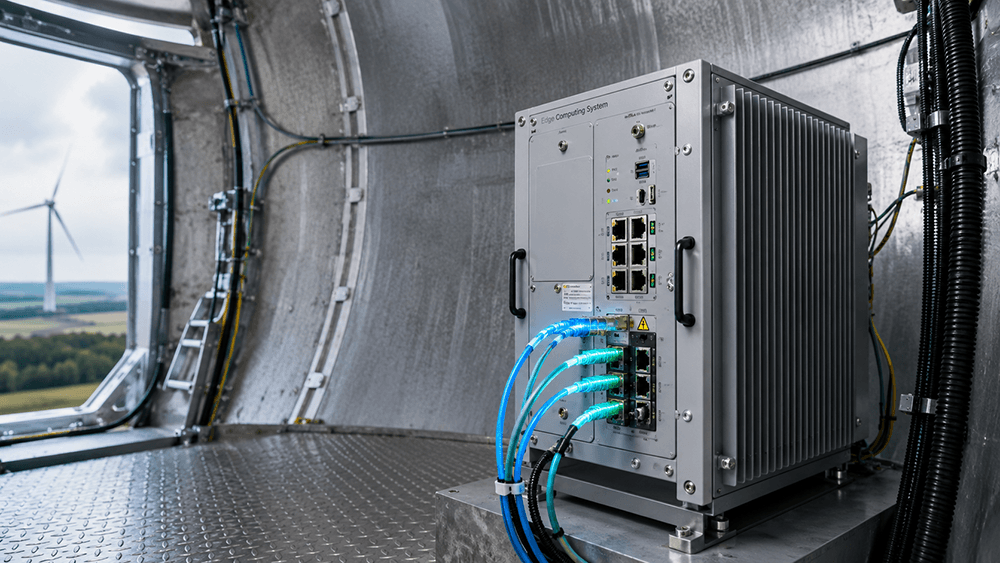
To resolve these bandwidth and operational challenges, the company implemented WThink’s Cloud-Edge Integrated Architecture across its entire wind energy portfolio. This specialized framework deploys intelligent edge-computing nodes directly within the base of individual wind turbine towers or at site-level substations. These industrial-grade edge hosts are engineered to withstand extreme temperatures, continuous vibration, and moisture. Simultaneously, the system connects all site-level edge nodes to a centralized cloud platform at the corporate operations center. By splitting the computational workload, the architecture ensures that heavy data processing occurs locally, while global orchestration and data visualization remain centralized.
Localized High-Volume Processing and Smart Data Uplink
The integrated architecture optimizes data management through intelligent, localized processing. During autonomous drone blade inspections, the UAV transmits high-resolution thermal and optical images directly to the site’s local edge node. Utilizing built-in deep learning algorithms specifically trained on wind asset anomalies, the edge host analyzes the raw visual feeds frame-by-frame on-site. It instantly identifies structural defects such as surface cracks, delamination, and lightning damage. Once identified, the edge node filters out the redundant, healthy visual data, compressing the diagnostic results into lightweight alarm metadata and small cropped images of the flagged anomalies. This structured data is then uploaded instantly to the central cloud platform, minimizing bandwidth usage while ensuring the remote operations team receives immediate, accurate alerts.
Centralized Global Operations and Structured Analytics
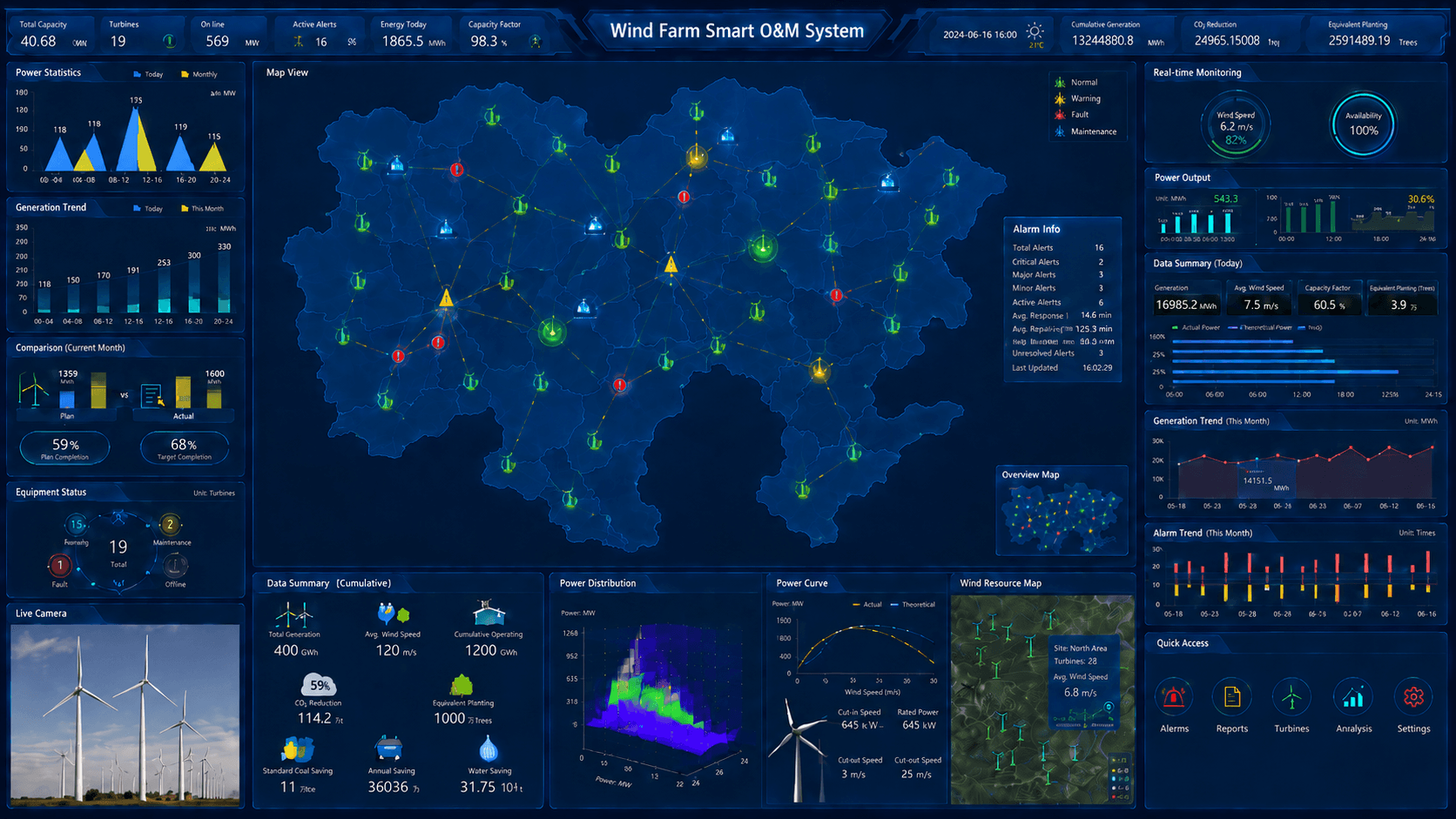
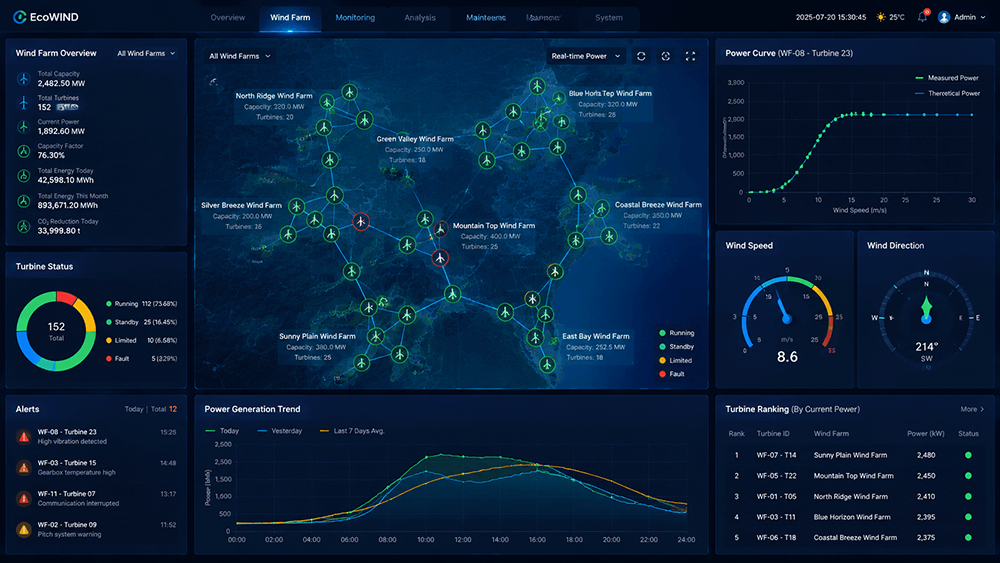
At the corporate headquarters, the centralized cloud platform receives the condensed data streams from all regional wind farms and aggregates them into a comprehensive global dashboard. The interface displays an interactive map view showing the real-time operational status of multiple wind turbine nodes connected across different geographies. Operators can analyze power curves, equipment statuses, cumulative generation statistics, and wind resource maps on a single screen. When a specific turbine flags an anomaly, the system links the alarm directly to the local edge diagnostic report, displaying the exact severity level and coordinate location of the defect. This unified oversight allows asset managers to evaluate the health of their entire portfolio in real-time and coordinate proactive, optimized maintenance campaigns.
Business Value and Long-Term Operational Benefits
The implementation of WThink’s cloud-edge integrated architecture has successfully eliminated the communication and diagnostic bottlenecks that previously hindered remote wind operations. By enabling local processing of high-volume inspection data, the diagnostic cycle for critical structural anomalies has been reduced from weeks to under ten minutes. This rapid response capability has allowed maintenance teams to repair minor blade damages before they escalate, preventing catastrophic failures and stabilizing grid power output. Furthermore, the massive reduction in cellular data transmission has dramatically lowered operational telecom costs, proving that a coordinated cloud-edge framework is a highly practical and scalable approach for modern digital wind energy management.