

Project Background and the Challenges of Siloed Wind Operations
Managing a massive portfolio of wind energy assets across different geographical zones—such as onshore plains, high-altitude mountain ridges, and offshore blocks—is a complex logistical task. A leading power utility with over 1.2GW of wind capacity spread across dozens of remote sites struggled with highly fragmented operations. Each wind farm historically ran its own proprietary SCADA monitoring system, while security alerts and drone blade inspection data were managed through separate, localized databases. This siloed operational structure forced the headquarters’ engineering team to toggle between multiple disconnected platforms, making it difficult to maintain a consistent, overall view of asset performance, coordinate multi-site security, or compile standardized energy generation reports.
Operational Obstacles in Large-Scale Portfolios
This lack of integration created significant operational bottlenecks and delayed response times. When a turbine experienced a gradual drop in power output, identifying whether the issue was caused by wind shadow, mechanical wear, or aerodynamic blade degradation required hours of manual data collation from different systems. Furthermore, because drone flight logs and maintenance histories were kept separate from real-time generation metrics, dispatching repair crews was often reactive. Site operators had to manually verify which turbines were offline and check parts availability before issuing work orders, which led to prolonged, unnecessary downtime and directly impacted the utility’s daily power generation revenue.
Implementing WThink’s Unified Central Control Platform
To overcome these coordination barriers, the utility deployed WThink’s Centralized Multi-Wind-Farm Control system. This advanced digital platform serves as a unified command center, integrating real-time operational telemetry, autonomous drone inspection schedules, site-security monitoring, and maintenance workflows into a single interface. Operating at the utility’s headquarters, the platform unifies data streams from hundreds of turbines of various models and manufacturers, providing a consolidated, high-fidelity view of the entire renewable energy portfolio.
3D Digital Twin and Operational Parameter Consolidation
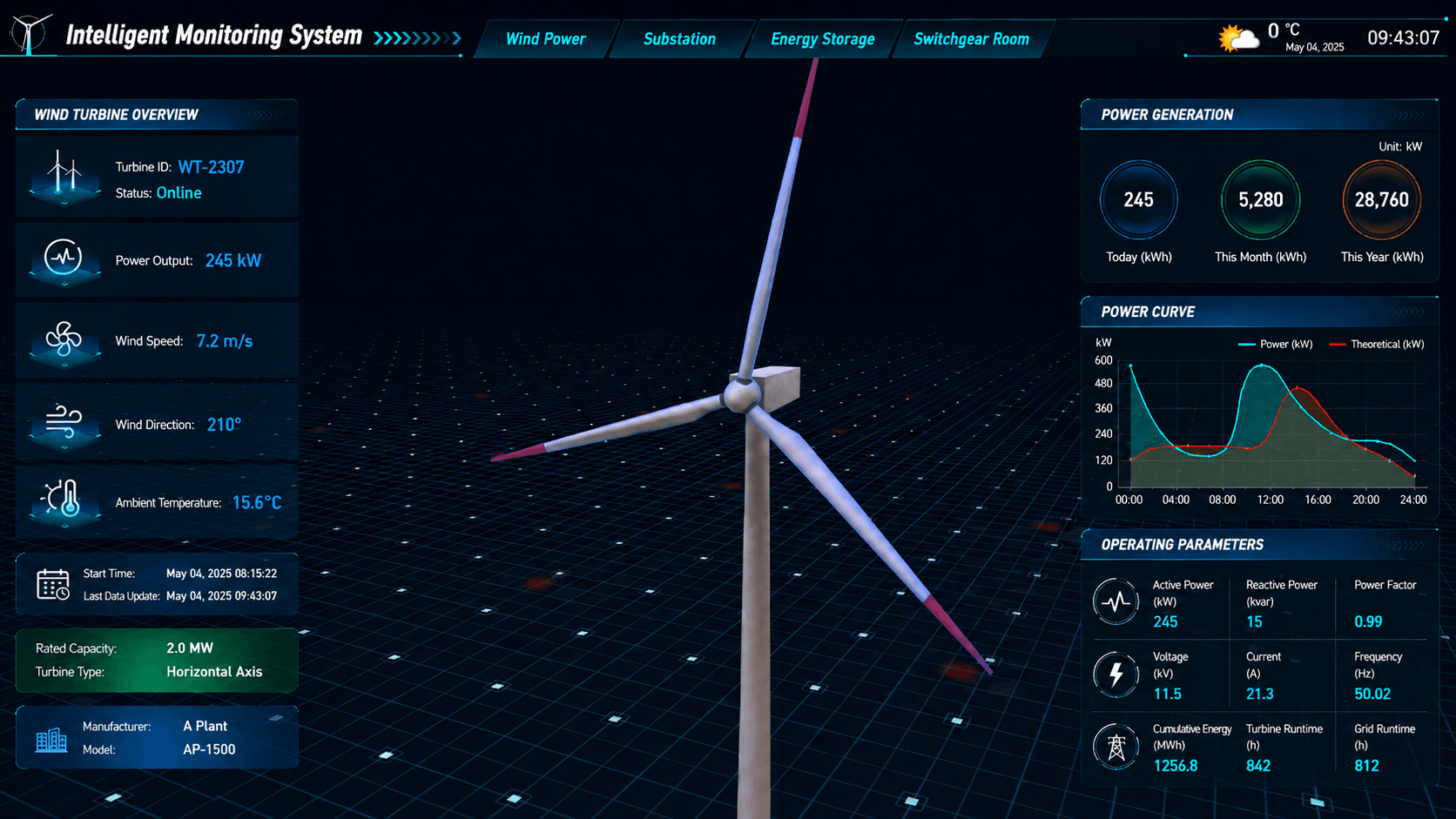
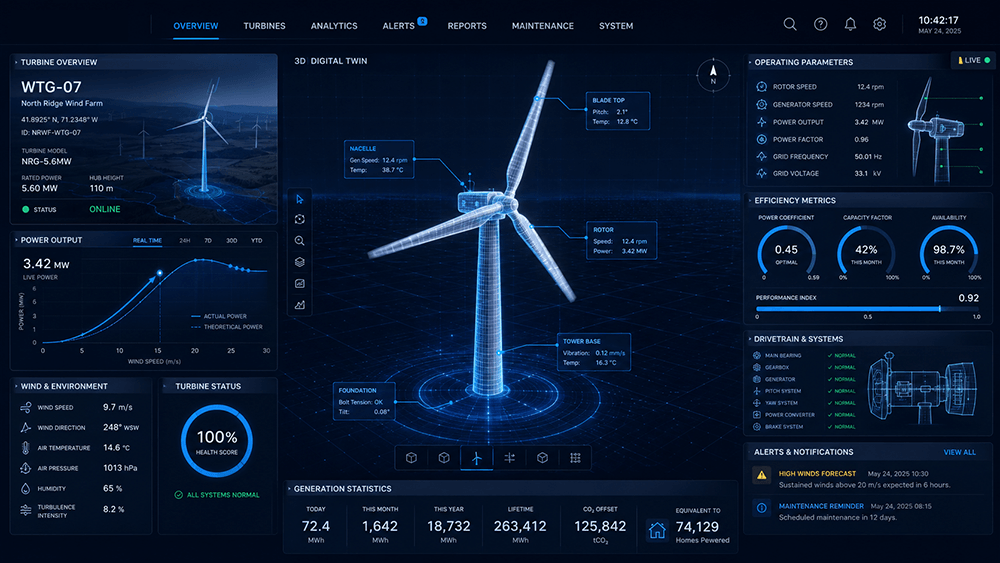
The centralized platform unifies site-specific monitoring by generating dynamic 3D digital twins for every active wind turbine in the field. From the central dashboard, operators can select any specific unit—such as Turbine WT-2107—and instantly view its live operating parameters alongside its historical generation curves. The system aggregates essential SCADA telemetry, including power output, wind speed, wind direction, ambient temperature, active/reactive power, voltage, current, and grid frequency. This live data is automatically plotted against the turbine’s theoretical power curve. This immediate correlation allows headquarters’ engineers to identify aerodynamic underperformance or minor electrical anomalies without having to wait for manual site reports.
Streamlined Maintenance Workflows and Asset Optimization
The integration of security, inspection, and operations within a single system closes the loop between fault detection and remediation. When a turbine’s local edge node flags a blade defect during an automated drone patrol or detects an intrusion on-site, the platform automatically logs the alert directly under the affected turbine’s operational record. Dispatchers can review the turbine’s complete runtime history, cumulative generation trends, and active maintenance logs on a single screen. This consolidated historical context allows central management to coordinate predictive maintenance campaigns, optimizing spare parts inventory and strategically scheduling repair tasks during periods of low wind speed to minimize revenue losses.
Business Value and Operational Results
The deployment of WThink’s Centralized Multi-Wind-Farm Control platform has successfully unified the client’s fragmented clean energy operations. The centralized platform has reduced administrative overhead, eliminated data inconsistencies across different sites, and dramatically cut down the time required to diagnose underperforming turbines. By merging operational monitoring, security, and automated inspections into a single system, the operator has maximized energy capture, lowered physical labor costs, and established a scalable, data-driven standard for multi-site renewable energy management.